INTRODUCTION
Key takeaways
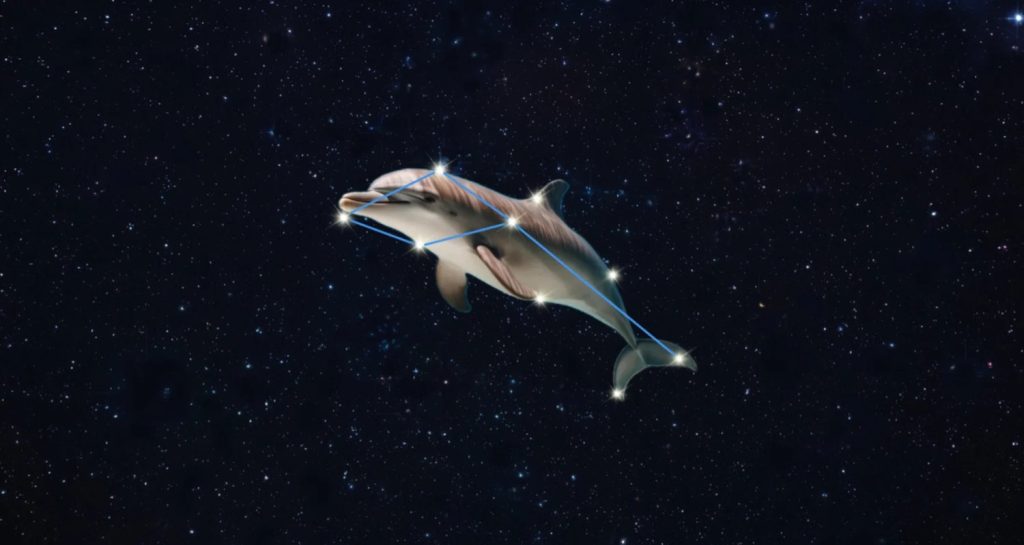
- Delphinus is a small, dim, but distinctive constellation in the northern hemisphere.
- It is one of Ptolemy’s original 48 constellations.
- It represents the dolphin that saved Arion, an eminent 6th-century BC poet.
- It does not contain any Messier objects or meteor showers.
- Notable deep-sky objects: NGC 7006.
Beginner’s map of DELPHINUS
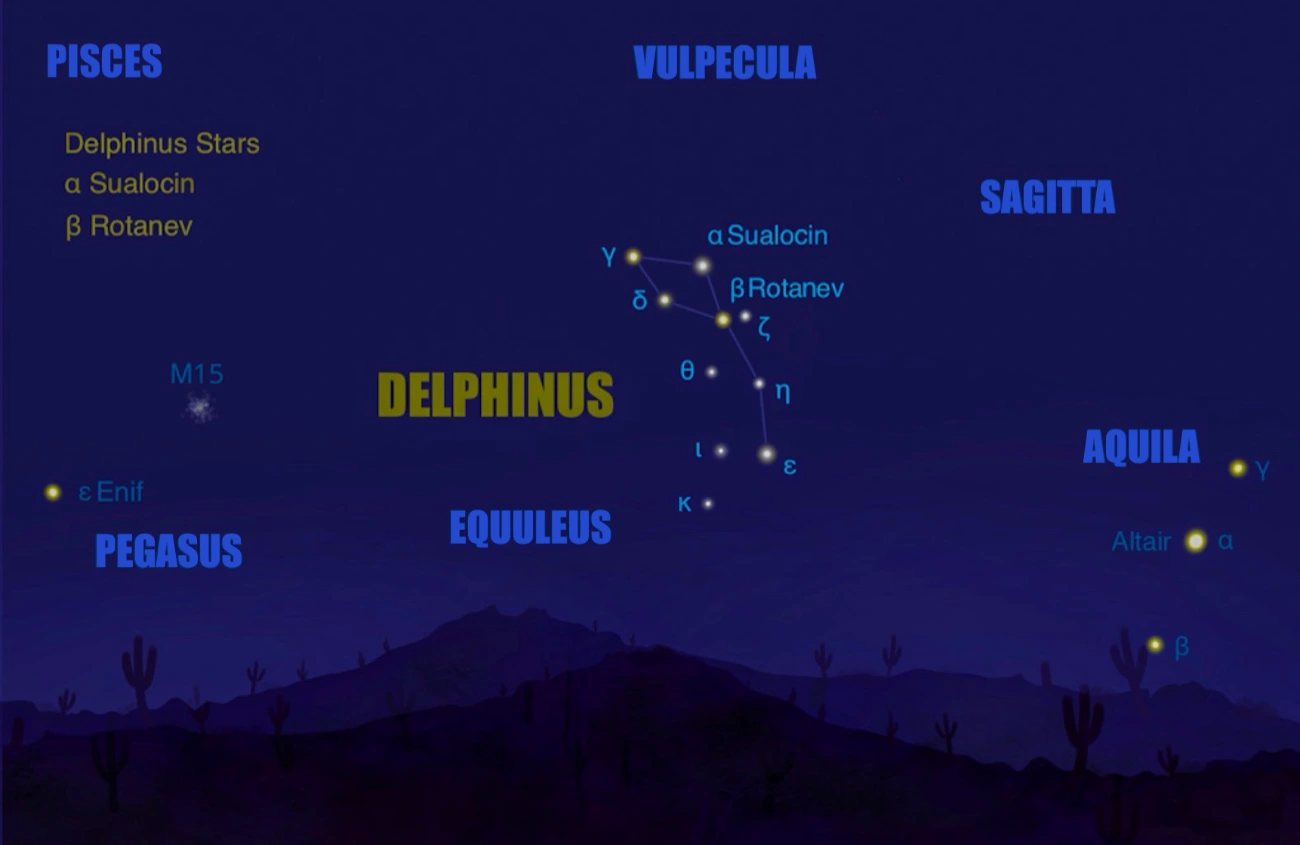
In contrast to Cetus, which can hardly propel itself out of the ocean and always stays close to the frothy horizon, another cetacean, Delphinus, has leaped so high that it has joined in the summer sky the constellation Aquilla, the eagle of Olympus.
Perhaps after swimming joyfully around the legendary ship Argo and playing with the Argonauts, it decided to reach the heavenly Lyre, the constellation Lyra. After all, ancient writers inform us that these delightful mammals love as much music as they love to play. And you would be hard-pressed to find a more melodic part of the heavens than that occupied by the lyre of Orpheus and echoed with the song of Cygnus.
THE MYTH OF PISCES AUSTRINUS
Myth at a glance
Delphinus represents the dolphin that saved the ancient poet Arion or Amphitrite
Unlike the leaping dolphin, we will take a deep breath and dive briefly into mythology to discover its story and origins. And, as is often the case with the Ptolemaic constellations, we can expect to return to the surface, bringing at least one story with us. Sure enough, there are three.
The first begins with a well-known figure from antiquity. The Greek poet Arion. Just like Delphinus is a creature of the sea and sky, Arion is a creature of reality and myth. He was born in Mithymna, the second-largest town on the island of Lesvos, which Achilles had besieged due to its alliance with Troy. Lesvos was an island with a strong poetic tradition, considering it was the home of the most famous female poet of antiquity, Sappho.
Arion, a sought-after poet known all over the Mediterranean, spent several years at the court of Periander, the second tyrant of Corinth and one of the seven sages of Greece. He was the winner of musical contests and found great fame and wealth in the Greek colonies of South Italy and Sicily. After these impressive successes, he decided to return to Corinth.
Having grown to trust nobody as much as the Corinthians, he chartered a vessel with a Corinthian crew and set off from Tarantum to Corinth. However, two things happened soon after the ship disappeared from the horizon and was sailing in the open sea. Arion dreamed of Apollo, who advised him to have faith in him, and concurrently, the crew attacked him to kill him and seize his wealth.
The crew gave him two choices. Either commit suicide and get a proper burial at Corinth, or leap into the sea. Granted one last wish, Arion chose to sing one last time. They let him go to the back of the ship, where he sang a hymn to Apollo and leaped into the Mediterranean as the vessel continued its voyage to Corinth.
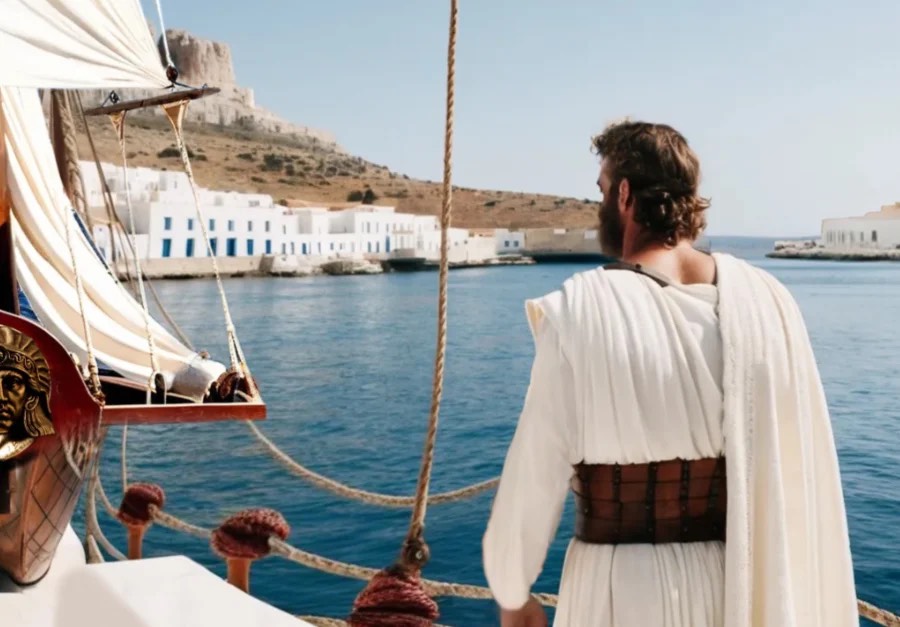
Arion left the city of Tarantum in Sicily and, full of riches, sailed for Corinth in south Greece.
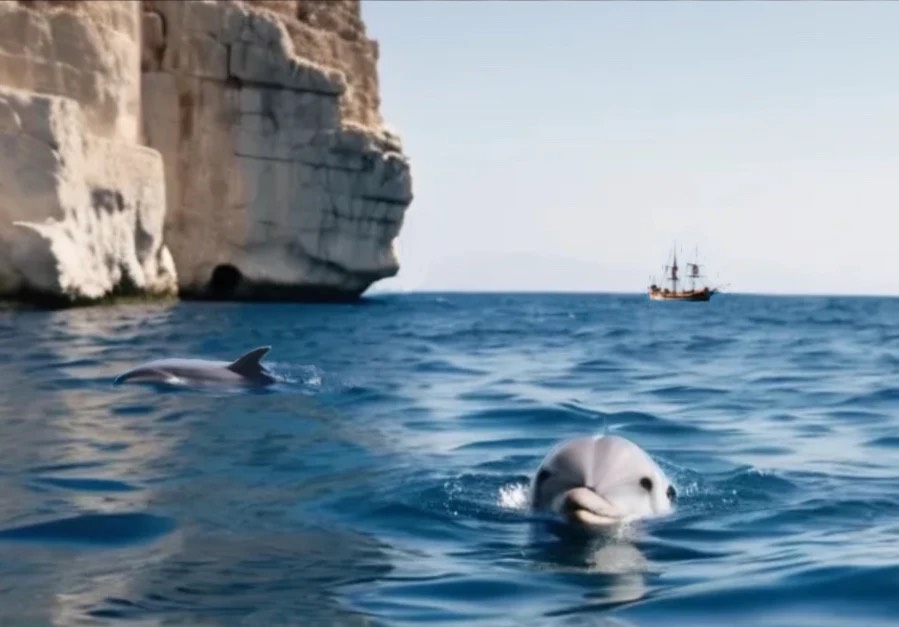
Soon after Arion jumped into the sea, one of the dolphins came to his rescue.
Nevertheless, the dolphins that had momentarily gathered around the ship before quickly dispersing were something the crew did not notice. Arion’s song had charmed the dolphins, and, miraculously, one of them carried him safely to the cape of Tainaro, just south of Corinth. He reached the city after a protracted walk and told Periandros everything that had transpired.
Periandros, not fully convinced by Arion, awaited the ship’s arrival. When the crew arrived, he asked them, full of fake anxiety, why Arion was not with them, and they swore that Arion had stayed in Tarantum. Then, just as suddenly as he had disappeared, Arion appeared before them. Startled, they could not avoid admitting the truth, and they were led to death. Afterward, an unknown sculptor erected a sculpture of Arion and the dolphin on the cape of Tainaro, and Apollo put the dolphin in the sky.
Unsurprisingly, the second version of Delpinus’ origin involves the god of the sea, Poseidon. Nereus, son of Pontos and Gaia or Oceanus and Tethys, was a God of the sea preceding Poseidon. His wife was the daughter of Oceanus Doris and they had fifty daughters of legendary beauty. One of them was Amphitrite. (Asteroid 29 is named in her honor.)
One day, Amphitrite was dancing with her sisters on the Cycladic island of Naxos when Poseidon saw her and, impressed by her beauty and grace, abducted her. He then created an idyllic island for them, Paxoi, by hitting the southern part of Kerkyra Island (Corfu Island) in the Ionian Sea with his trident.

Amphitrite left the Aegean Sea and traveled far to the west of Africa, to the land of the Titan Atlas, whom Perseus had turned into the towering Atlas mountain.
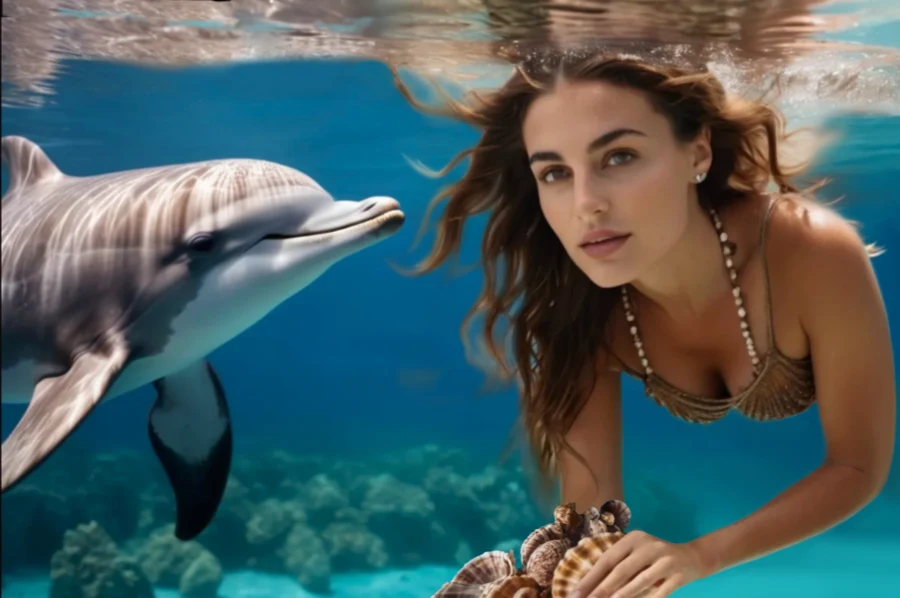
One of Poseidon’s dolphins found Amphitrite beyond the pillars of Heracles (Roman Hercules) and persuaded her to return to the Aegean Sea.
Eratosthenes gave us another version of the romantic adventure. Poseidon fell in love with Amphitrite, but the nymph wished to keep her virginity and tried to hide from him far away, beyond the pillars of Heracles in the land of Atlas. To find her, Poseidon dispatched a school of dolphins. One of them saw her and convinced her to accept Poseidon’s love. Out of gratitude, the god of the sea placed Delphinus in the sky. Since then, both have been depicted in art accompanied by dolphins.
We are not done with beautiful Amphitrite yet, however. We will meet her again in the story of the constellation Hercules.
Yet another god is associated with the origins of this most charming, immortalized mammal. Dionysus. There are two versions of this myth. Dionysos wanted to travel from the island of Ikaria to the nearby island of Naxos to spread his worship among its inhabitants. He hired a crew of Tyrrhenian sailors to take him to the Cycladic island, but they found the prospect of selling him as a slave in Asia more lucrative.
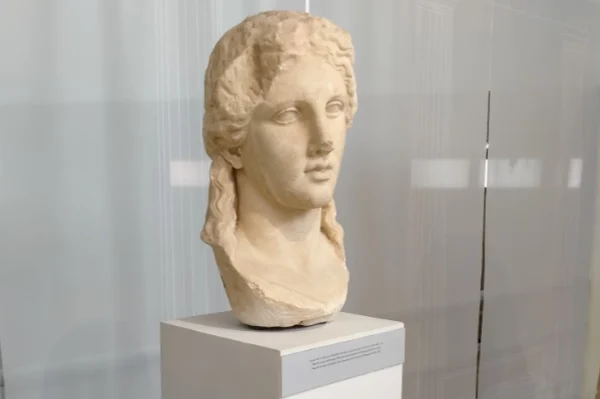
Marble bust of the god Dionysos. Archaeological Museum of Limenas, Thassos Island, Greece.
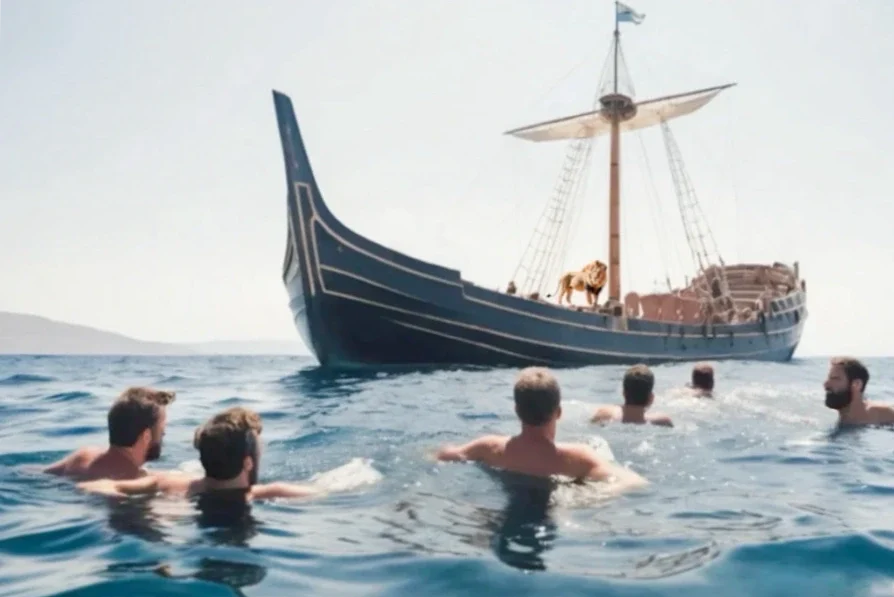
As Dionysus turned into a lion, his panicked abductors jumped overboard.
Realizing their sinister plan, Dionysus transformed the oars into snakes, entangled the ship with ivy, and unleashed an eerie sound from invisible musical pipes. Maddened, the sailors jumped overboard, where they transformed into dolphins. Repentant, they accompany ships, saving mortals from drowning ever since.
In the second version, Dionysus, an astonishingly handsome god who often transformed into a lion, was on the beach of Chios, one of the Aegean islands. A small pirate ship happened to be sailing close to the coast, and he caught the eye of the Tyrrhenian pirates. His overall looks left them no doubt that the young man could only be a king’s son. Excited by the prospect of a big ransom payout, they attempted to capture him.
However, they could not put him into bonds, no matter how hard they tried or what tactic they deployed. Dionysus, tranquil and smiling, effortlessly remained untouchable. When the ship sailed away in deep waters, a giant ivy coiled around the ship like a huge snake, and Dionysus appeared as a fearsome lion on the deck. The panicked pirates jumped overboard and were transformed into dolphins.