INTRODUCTION
Key takeaways
- Crater is a small, dim constellation in the southern hemisphere.
- It is one of Ptolemy’s original 48 constellations.
- Rich in mythological connections, it represents a wine goblet.
- It does not contain Messier objects.
- The name of the brightest star is Alkes.
Beginner’s map of SCORPIUS
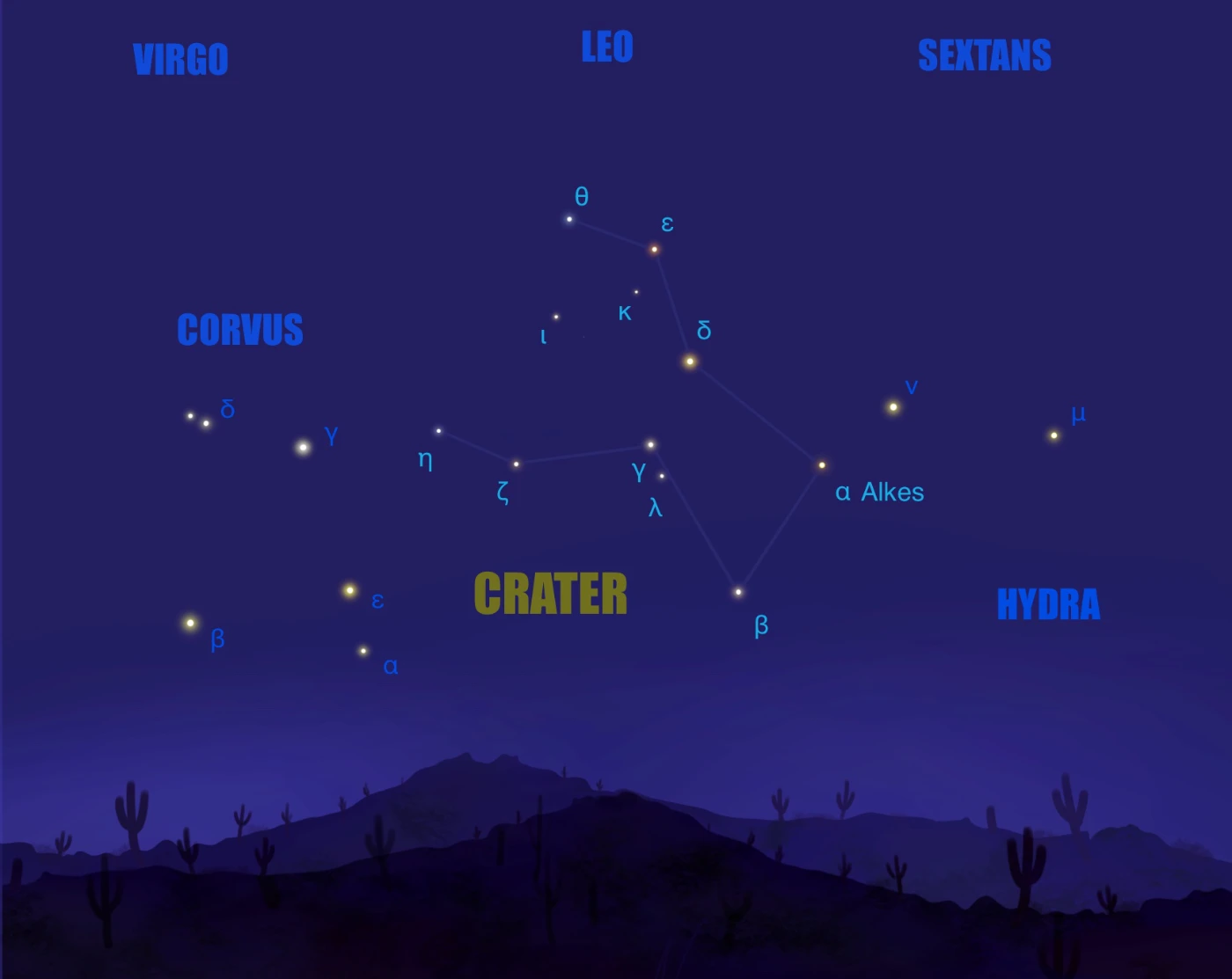
In the northern hemisphere’s spring, the southern part of the sky is dominated by dim constellations that bear little resemblance to the ones that graced the same part of the sky in the winter. Dominated by the huge constellation Hydra, it hosts a few small constellations endowed with disproportionally rich mythological significance. One of those is the small, dim, and often overlooked constellation Crater.
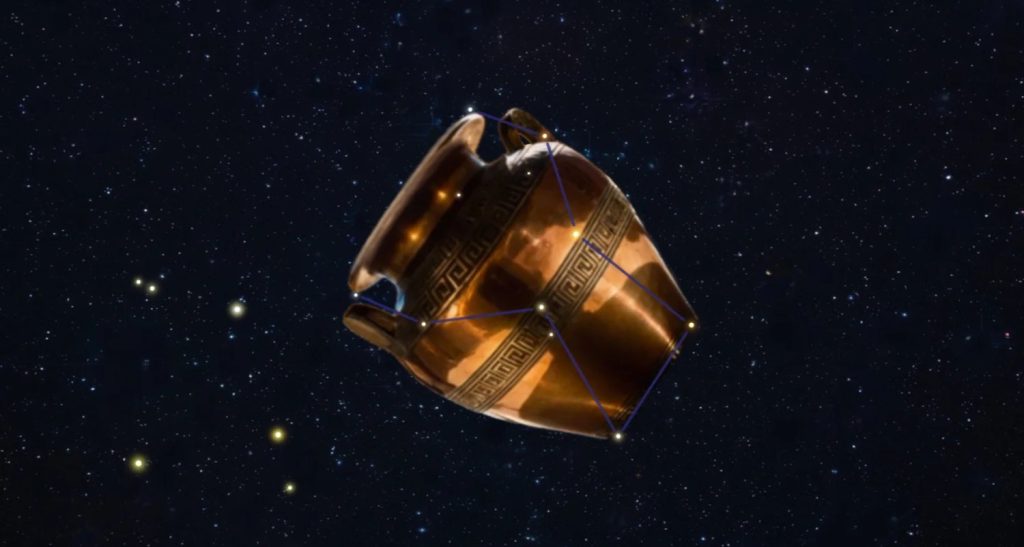
Crater represents a heavenly goblet full of Dionnysus’s fine, old wine, but its placement between the hundred-headed Hydra and the Nemean Lion forbids us mortals from even thinking of tasting it. Instead, since we are no match to Heracles, we will get a taste of its rich mythology.
THE MYTH OF CRATER
Myth at a glance
Crater represents
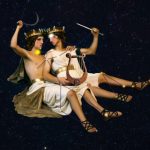
There are several myths associated with the constellation Crater. We will start with the myth that involves the god of wine, Dionysus. Crater is the wine goblet he gave to a farmer, Ikarios. In this myth, the main characters are Ikarius, a farmer from Attica, and his daughter, Erigone. One day, during the reign of Pandion in Athens, Ikarios had the honor of hosting Dionysus when the god of wine visited Athens. Dionysus was pleased and repaid the hospitality of Icarius by teaching him the art of growing vines and making wine, thus rendering him the first mortal to practice viticulture. Dionysus warned Ikarios to treat this new art wisely and left.
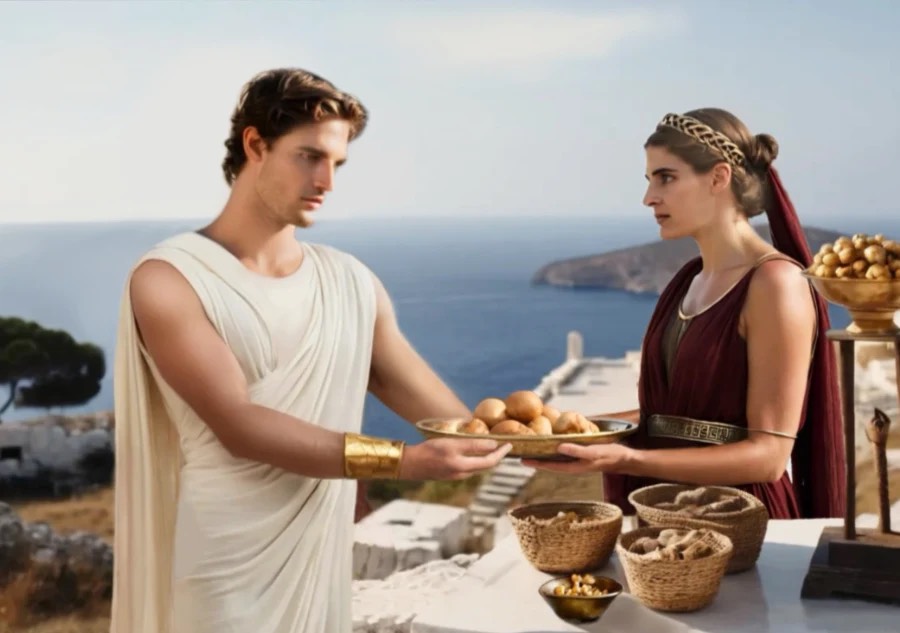
Ikarios, accompanied by Maira, offered wine to Acme and other locals.
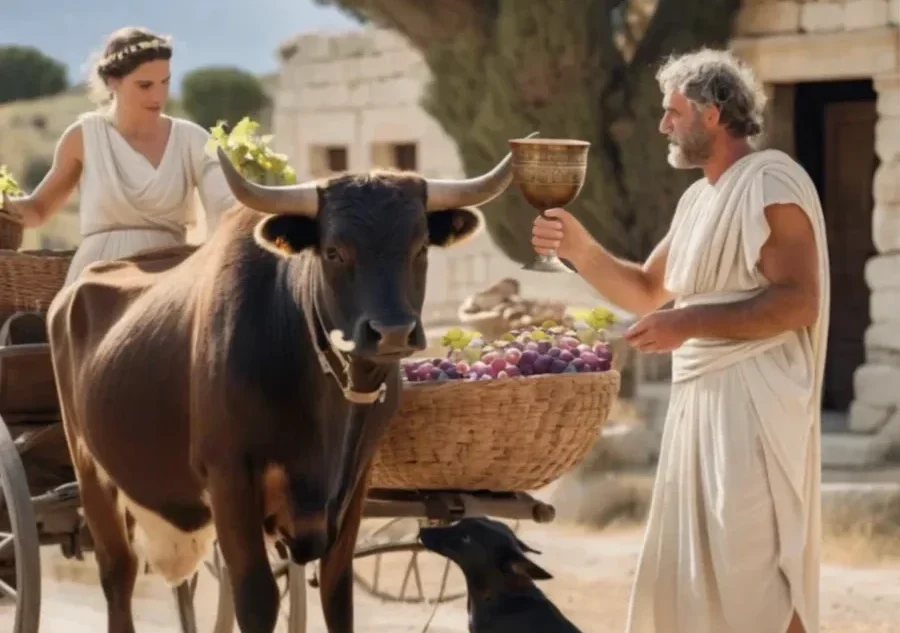
Irigone set out to find her missing father with the help of Maira.
Ikarios did not take the advice of Dionysus seriously and, thrilled by the taste of the divine gift, set out to spread its use. When he finally had enough, he poured it into sacks, climbed into his ox-drawn carriage, and, accompanied by his faithful dog Maera, offered the onlookers and passersby wine. Among the first to taste the gift of Dionysus were two shepherds and a beautiful young woman named Acme.
Acme enjoyed the wine of Ikarios, but the shepherds’ reaction would make him realize the gravity of Dionnysus’s warning. Having drunk wine for the first time in their lives, they attributed the ensuing dizziness and double vision to poisoning. Being drunk and under the impression that Ikarios had tried to kill them, they attacked him, killed him, and threw his body in a well under a pine tree.
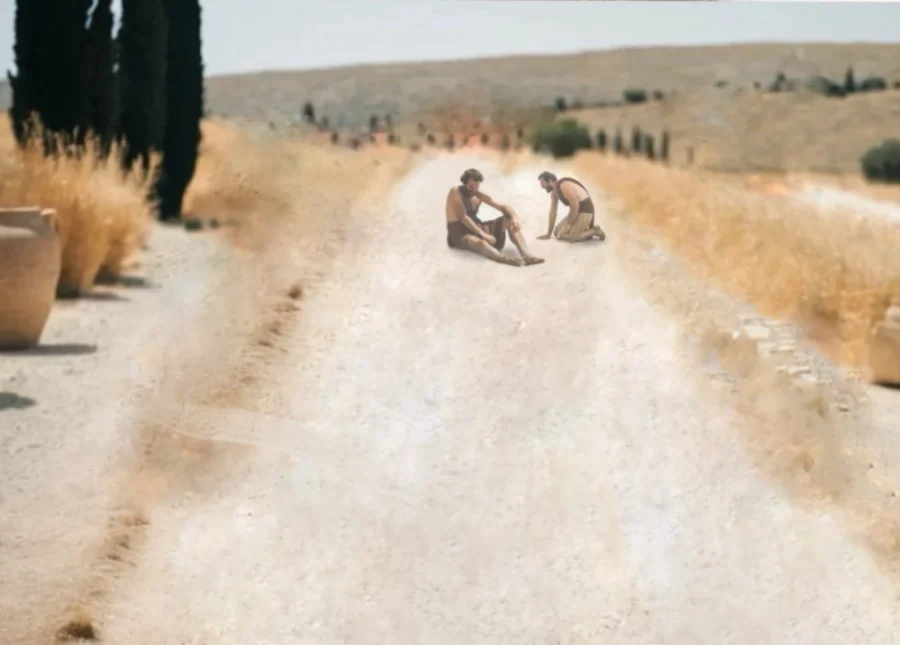
Ikarios, accompanied by Maira, offered wine to Acme and other locals.

Irigone set out to find her missing father with the help of Maira.
As time passed, his daughter Erigone, growing anxious, set out to find him and was led by their hound Maera, who witnessed everything, to the well. Shocked, she discovered her father’s corpse, buried it, and, distraught, hanged herself from the pine. Just before she died, Erigone prayed that the same fate should fall upon the daughters of Athens until the punishment of her father’s murderers, who fled Attica.
Many young women mysteriously met the same fate as Erigone after that fateful day, and the Delphic oracle revealed that Erigone’s demands for justice were what ultimately led to their deaths. Aristeus, son of Apollo and Cyrene, would administer justice when he went to Kea Island at Apollo’s recommendation. He would become the constellation Aquarius, and Maera would become the constellation Canis Minor.
Another version of its origin connects Crater to the myth of the Aloades. That was the name of the sons of Poseidon, Otus, and Ephialtes. Their growth was astonishingly fast, as they gained tens of inches in height every year. When they reached a height well over thirty feet, they threatened the gods with war.
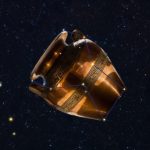
They were powerful enough to capture the god of war, Ares (Roman Mars), and imprison him inside a large copper vessel for thirteen months. However, Hermes managed to free him, and Artemis later killed the brothers on Naxos Island. In this version, the constellation Crater represents the copper vessel.
Crater is linked to yet another myth and wine goblet—the myth of Mastusius and Demiphon. Demiphon was king of Elaeunda on the Thracian Peninsula. This place was notable because the first Achaean warrior killed in the Trojan War, Protesilaus, was buried there. Once, famine plagued his kingdom, and seeking guidance, Demiphon consulted the oracle of Apollo. The oracle informed him that, to appease the gods and stop the famine, every year he had to sacrifice one girl from the noble families of the city.
However, Demiphon did not include the names of his daughters in the drawing process. This led Mastusius, a nobleman, to refuse to have the names of his daughters drawn unless the daughters of the king were included too. Angered, the king handpicked and sacrificed one of Mastusius’ daughters. Mastusius hid his feelings and vowed revenge.
The years passed, and this tragedy faded from memory. But not for Mastusius. One fateful day, he invited the King and his daughters to participate in a sacrifice. At some point, the daughters separated from their father, and Mathusius, seizing the moment, killed them. He mixed their blood with wine, filled a goblet, and offered it to Demiphon. Demiphon drank, and realizing what had happened, he threw Mastusius and the cup into the sea. Henceforth, the sea was known as Mastusia, and the port as Kratera, after krater, the Greek word for the wine cup.
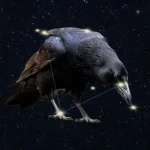
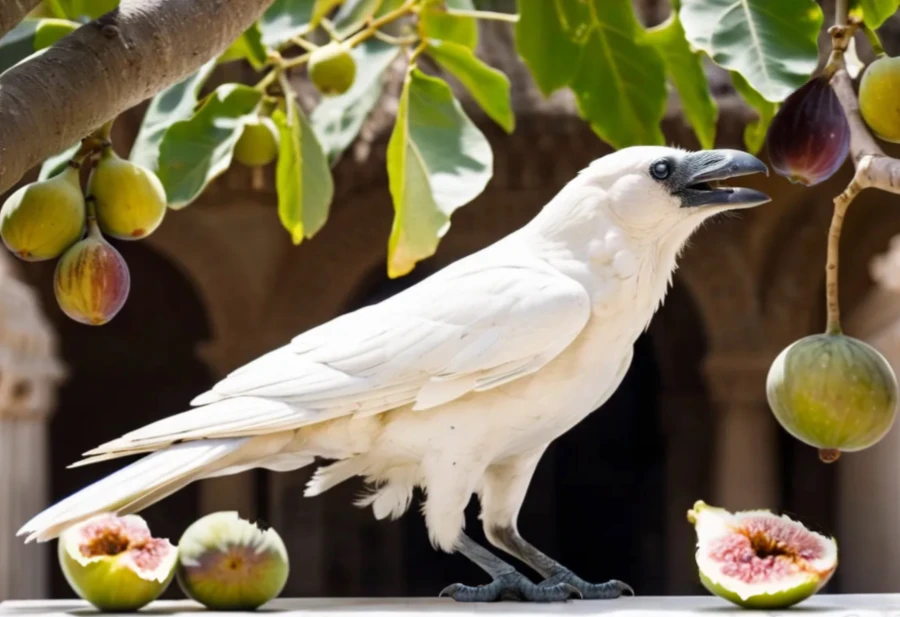
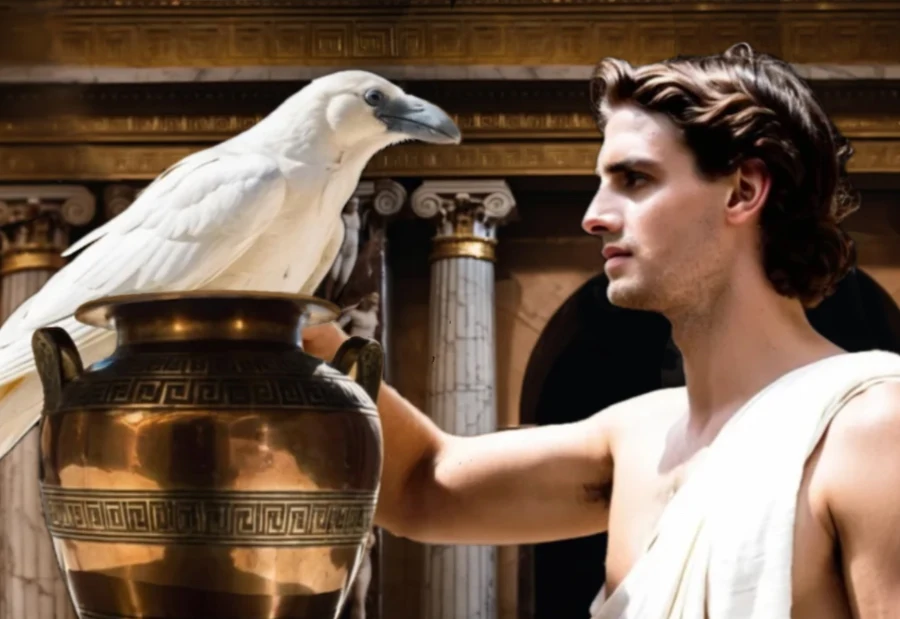
We started our exploration of the mythology of Crater with the god Dionysus and will finish it with the god Apollo and his sacred bird, the raven. Pure water was an essential component of the ritual of sacrifice in antiquity. Once, some people gave a raven a jug and asked him to find and bring pure water for a sacrifice. The raven found a suitable spring, where a fig tree laden with semi-ripe, tasty-looking figs happened to grow. Succumbing to temptation, he decided to wait for the first of them to be fully ripe. When he finally ate them, with a full belly, carrying a jar full of water, and struggling in the Sirius-induced mid-summer heat, he made it to the spot of the sacrifice.
Ikarios, accompanied by Maira, offered wine to Acme and other locals.
Irigone set out to find her missing father with the help of Maira.
However, he knew he had to devise a credible excuse to justify his delay. So he found a snake and told the angry crowd how difficult it was for him to bring water when this snake, every day, drank all the water from the spring. Angered by the raven’s behavior, Apollo punished the bird, and to make an example of him that humans will never forget, he placed the crow, the snake, and the jug in the sky.
In a similar version of this myth, Apollo was the one who dispatched and had to wait for the delayed return of the raven, or the raven was the one who brought the news to Apollo of the death of his wife, Coronis. In the latter version, a disgruntled Apollo changed the color of the raven from white to black.
.