Stargazing Guide: Unveiling the Mysteries of the mythical goat
INTRODUCTION
Key takeaways
- Capricornus is a large, dim constellation in the southern hemisphere.
- It is one of Ptolemy’s original 48 constellations.
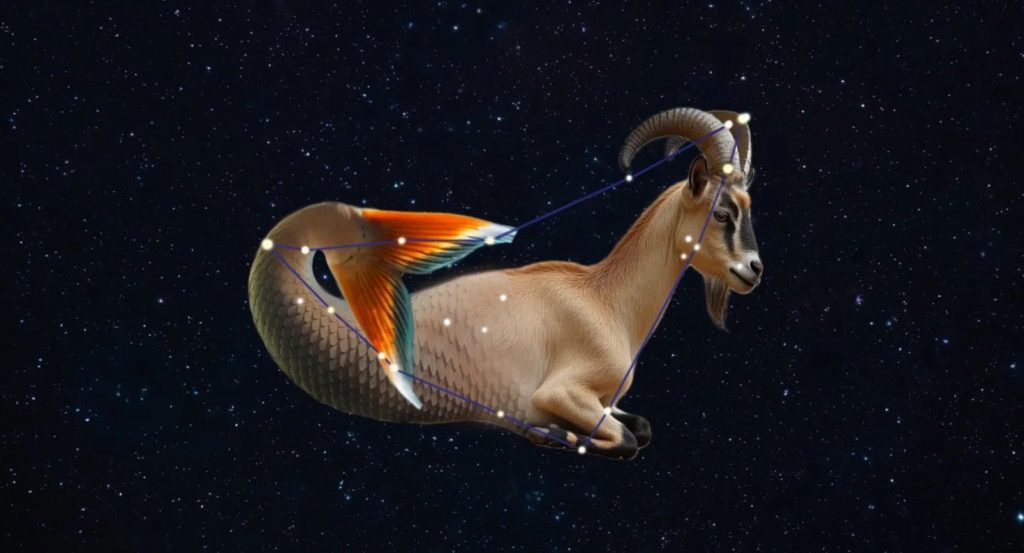
- It symbolizes the fishtailed goat that the god Pan changed into to flee the Typhon monster (typhoon).
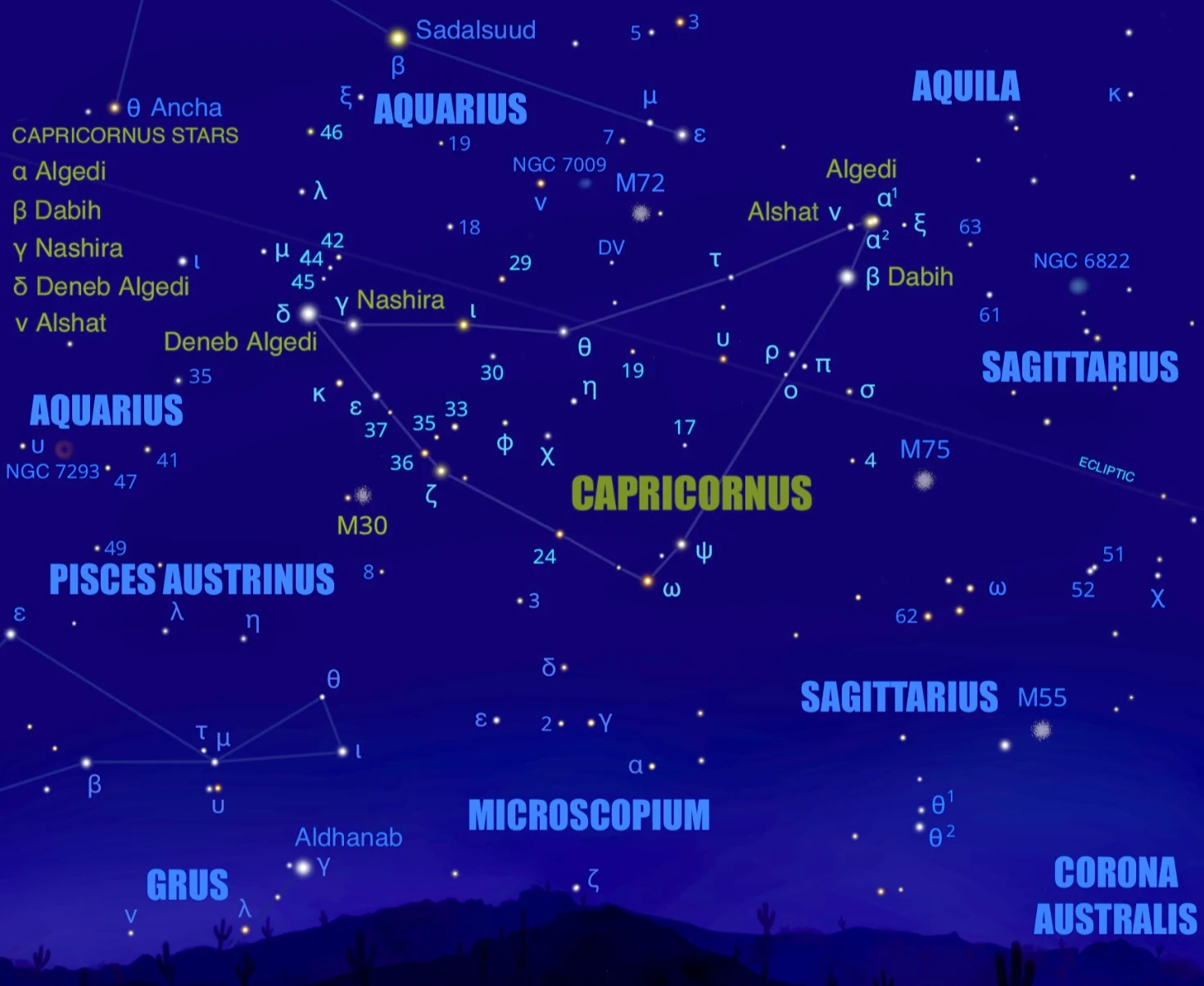
- It contains one messier object, the globular cluster M30.
- The brightest star’s name is δ, Dened Algedi, with an apparent magnitude of 2.81.
Beginner’s map of CAPRICORNUS
While the reckless young demigod Phaethon panicked as he drove the sun’s chariot through the horrific Scorpius constellation, for other panicked denizens of the sky, the panic came from creatures of the earth. In all cases, the hunted found refuge in rivers, which perhaps explains their respective constellations’ position low in the sky, as close as possible to the misty cover of the horizon’s trees and bodies of water.
One of these panic-inducing creatures, Typhon, was responsible for the placement of two well-known constellations in the sky. Piscis Austrinus and Capricornus. The myth of Capricornus is tied with Typhon, so before you grab your coffee and your biggest telescope (apart from M30, every other deep sky object is very faint), summon some courage, and let’s dive into the scary story of Capricorn.
Capricornus constellation myth
Myth at a glance
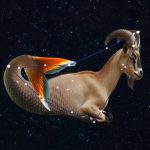
Capricornus represents the fishtailed goat into which Pan transformed himself to escape from Typhon.
Burning with the desire for revenge for the destruction of the giants by the Olympian gods, Gaia (the earth) united with Tartarus (the abyss) and gave birth to the greatest monster ever born. Typhon. His size spanned the known world, as he was as tall as the sky, and when he spread his hands, they extended from the far east to the far west. As if that wasn’t enough, his body was more or less covered with snakes and dragon heads. This fire-breathing, flaming rock-hurtling monster had one thing in mind: Olympus.
In the ensuing titanic struggle, the god Pan would play a major role in the Olympians’ victory. Typically considered the son of Hermes and Dryope, or Penelope, he was so ugly at birth that his mother ran away in fear. Given that the baby had goat’s legs, horns, beard, and tail, who could blame her? With the baby wrapped in hare skin, Hermes brought it to Olympus, where the gods were delighted and made fun of him. Growing up, he became a protege of the god of wine and ecstasy, Dionysus.
Pan lived in nature and could spend a large part of the day either sleeping or playing pipes, and while many would be delighted to hear his music, nobody would want to accidentally wake him up. A retiring god who much preferred to spend his time in the woods, often under his sacred tree, the pine, he was a protector of the herds and shepherds, and generally, he was a personification of nature. His reverence was restricted mainly to Arcadia, but after the Greco-Persian wars, it spread to all of Greece.
The reason was his alleged involvement in the battle of Marathon, which led to his reverence by the Athenians and the rest of the Greeks. It was said that he unleashed a very loud series of sounds reminiscent of his name, Pan, which spread panic among the Persians. Furthermore, Philippides related to the Athenians that he saw Pan while running from Marathon to Sparta to request Spartan assistance. The famous long-distance runner stumbled upon Pan in the foothills of a mountain, and the god called him and asked him why, having helped the Athenians so much and keen to help them in the future, they don’t revere him in return. These two happenings led the Athenians to build shrines and statues in veneration of Pan.
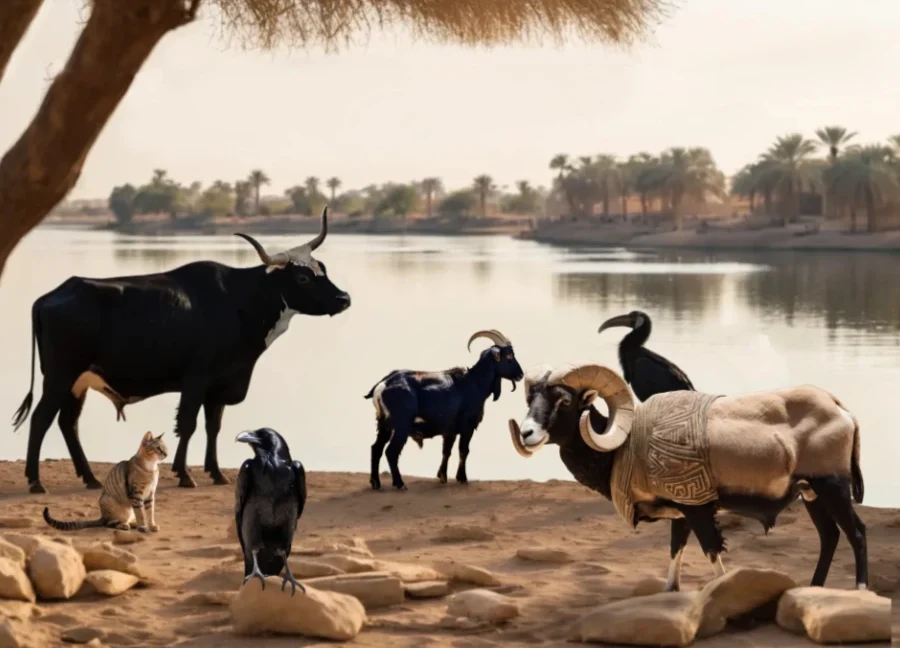
The gods fled to Egypt and disguised themselves as animals to escape Typhon.

Pan, disguised as a goat, had to assume a fish’s body to assist him in swimming.
He would be revered by the goods too, soon after the attack of Typhon at Olympus. For it was Pan’s advice that led the Olympians to seek refuge in Egypt and, by transforming themselves into animals, hide from their nemesis. Among others, Zeus changed into a ram, Hera into a cow, Artemis into a cat, Hermes into an ibis, Apollo into a raven, Hephaestus into a bull, Dionysus into a goat, and Pan changed his lower body into a fish when the goat-legged god realized he could not swim well after diving into the Nile.
This transformation let them live to fight another day, and, as they finally accomplished what looked impossible and defeated Typhon (burying him under Aetna in Sicily), they expressed their collective gratitude by placing Pan in the sky. Just next to Aphrodite and Eros, who had similarly transformed themselves into fish. In more recent times, Pan was honored with the naming of asteroid 4450 in his honor, 4450 Pan.