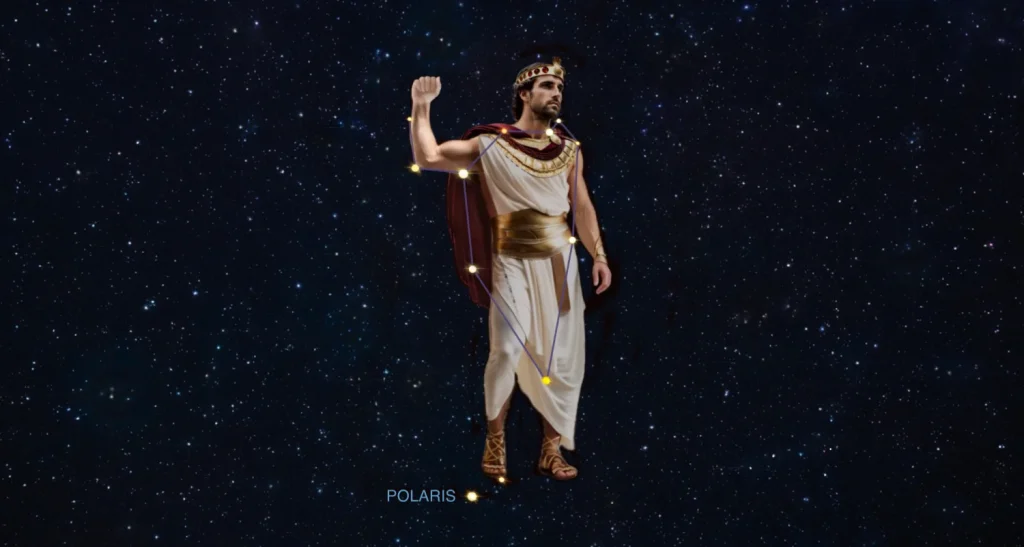
Stargazing Guide: Unveiling the Mysteries of the mythical King Cepheus
INTRODUCTION
Key takeaways
- Cepheus is a constellation in the northern hemisphere.
- It is one of Ptolemy’s original 48 constellations.
- It represents an ancient Greek king of the kingdom of Aethiopia and the father of Andromeda.
- It contains two very famous naked-eye stars: the prototype Cepheid variable star, Delta Cephei, and the distinctively red, colossal Herchell’s garnet star, Mu Cephei.
- The brightest star’s name is Alderamin.
STAR MAP OF CEPHEUS
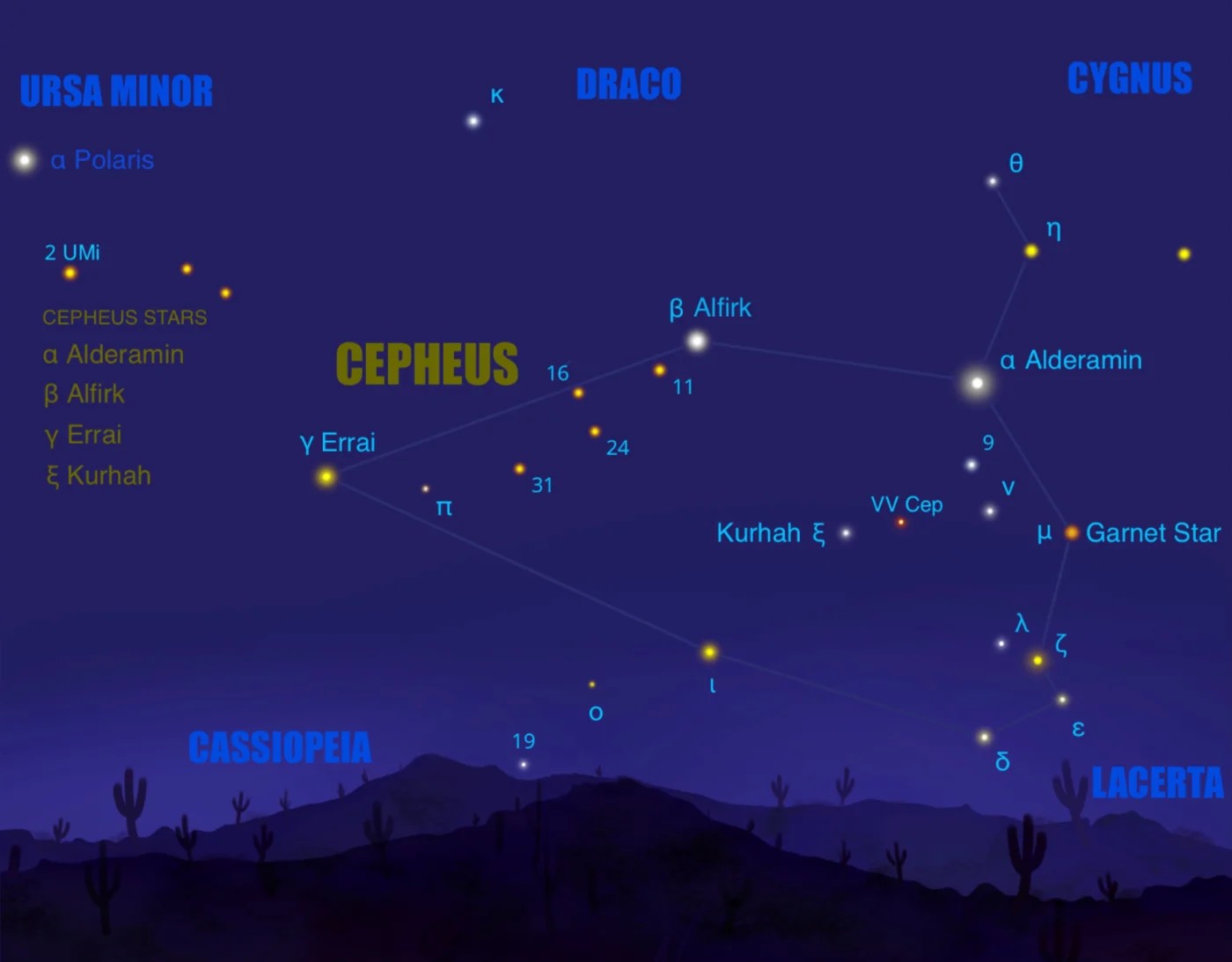
In the vast expanse of the northern night sky, the legendary Cepheus constellation almost touches the pole star and is flanked by the most beautiful mammal of the sky, the stately African giraffe, the constellation Camelopardalis. A very fitting celestial companion for the mythical Greek king of the legendary kingdom of ancient Aethiopia. After all, giraffes roamed the lands of ancient Aethiopia, which covered parts of northeast Africa and the Near East, and the Greek king would use the exact word “Camelopardalis” when referring to this stunningly beautiful animal since this was and remains to this day the Greek word for the giraffe.
However, not all the celestial neighbors of Cepheus are so benign and adorable. Immediately to his celestial right lies the bane of Hercules, the fearsome dragon that guarded the golden apples of the garden of Hesperides, which he fought in the eleventh labor, and the sprawling constellation Draco. To make matters worse, very close lies yet another carnivore, the thankfully less dangerous small bear, Ursa minor. King Cepheus is not alone in his celestial kingdom. His wife, Queen Cassiopeia, lies to his celestial left, and his beloved daughter, Princess Andromeda, is not far behind. All three, though, look as if trying to reach for the safety of the North Pole and flee the subtropical celestial waters that hide the horrible sea monster, Cetus, that almost destroyed Aethiopia and ended the life of Andromeda.
What was once a kingdom blessed with the treasures of the land, the Nile, and the Mediterranean Sea, such as amazing animals, beautiful plants, medicinal herbs, spices, gold, gemstones, ivory, and myrrh, is now a celestial kingdom dotted with bizarre stars, ancient star clusters, obscure galaxies, and innumerable astronomical wonders. Some of them are accessible to mere humans like us.
So grab your binoculars or telescope, choose your eyepieces, and dust off your favorite star atlas, but don’t go out for stargazing just yet! Before traveling thousands or millions of years into the past by gazing through your telescope, let’s briefly travel a few thousand years back by diving into the fascinating myth behind this celestial king and his African kingdom from the comfort of your room.
Cepheus constellation myth
Myth at a glance
Cepheus and Cassiopeia were the king and queen of ancient Aethiopia, and they had one daughter, Andromeda. Cassiopeia’s vanity caused her to brag that she was more beautiful than the Nereids. This enraged Poseidon, and to appease him, Cepheus had to offer Andromeda fodder for a huge whale. In the nick of time, the hero Perseus saved Andromeda and married her.
But who was the mysterious king, Cepheus? Cepheus was the king of Ethiopia, the son of the king and queen of Egypt, Belus and Achiroe. Belus was the son of Poseidon and Lybia, while Achiroe was the daughter of the god Nile, the river. That made Cepheus a grandson of Poseidon. He had three brothers. Danaus, Egypt, and Phineus. His wife was Queen Cassiopeia, and they had a daughter, Princess Andromeda. Cepheus had promised his daughter to his brother Phineas, whom he would take as his wife. However, what unfolded later prevented him from honoring his vow.
It all started one unfortunate day when his lovely wife Cassiopeia bragged about her beauty and even dared the unthinkable. To boast that she and Andromeda were more beautiful than any of the fifty daughters of the sea god Nereus, the sea nymphs Nereids. This unvirtuous act of vanity and arrogance enraged the Nereids and the god Poseidon.
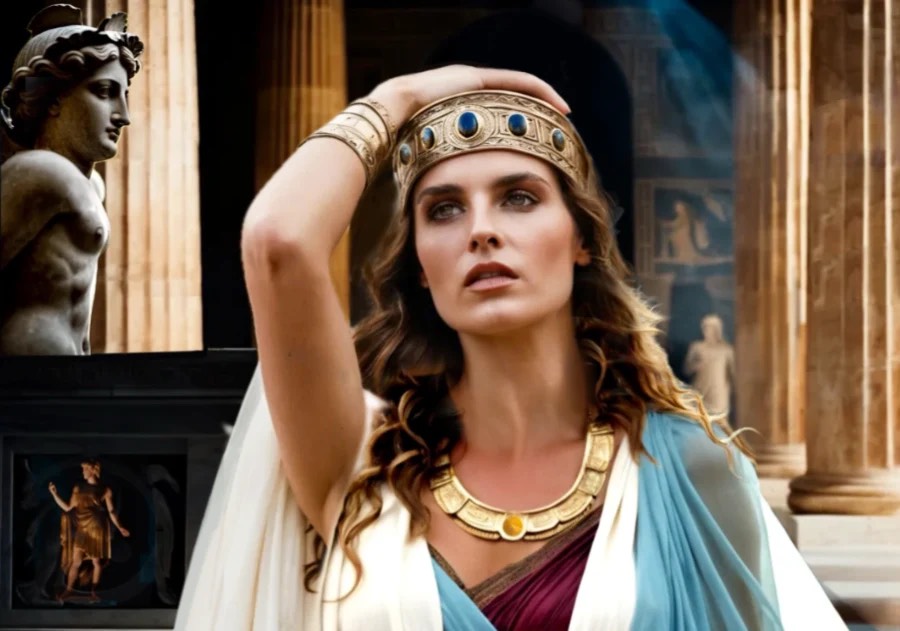
The vanity of Queen Cassiopeia was the cause of tragedy for Cepheus and his Aethiopian kingdom.

The arrogance and vanity of Cassiopeia offended the beautiful Nereids and Poseidon.
As a punishment, a furious Poseidon (Neptune in Roman) flooded the country and sent a monstrous whale to ravage it. Desperate Cepheus resorted to the help of the prestigious oracle of Ammon, but the message he was given was not what he had hoped. He was informed that the only way to salvage his kingdom was to sacrifice his beloved daughter by chaining her to a rock on a wild, rocky coast, literally offering her as fodder for the dreadful whale, Cetus. Devastated and pressed by his people, Cepheus finally did what he had to save his kingdom and chained Andromeda to a big, cold, wet rock.
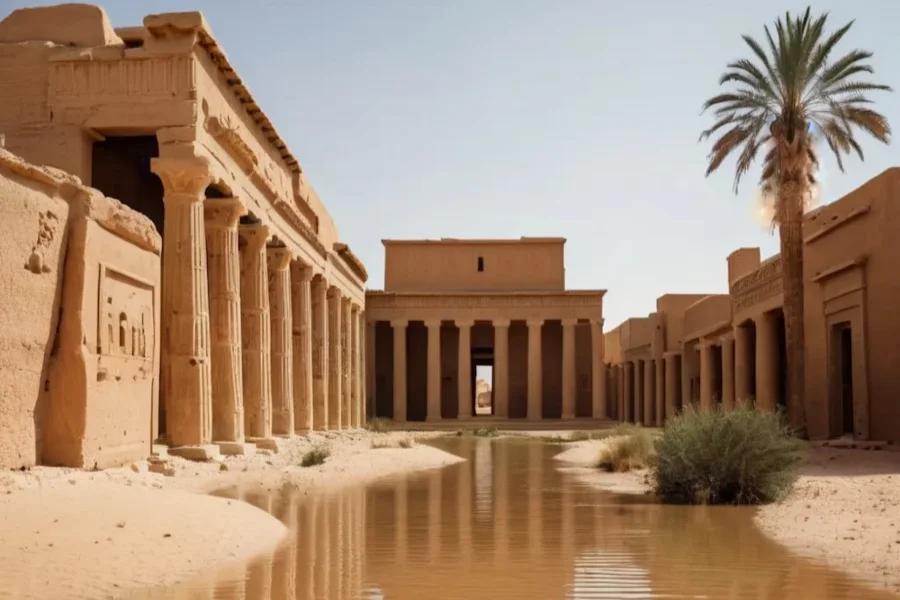
As floods spread across the land, the oracle of Amon made it clear that the only way to appease Poseidon would be through the sacrifice of Andromeda.
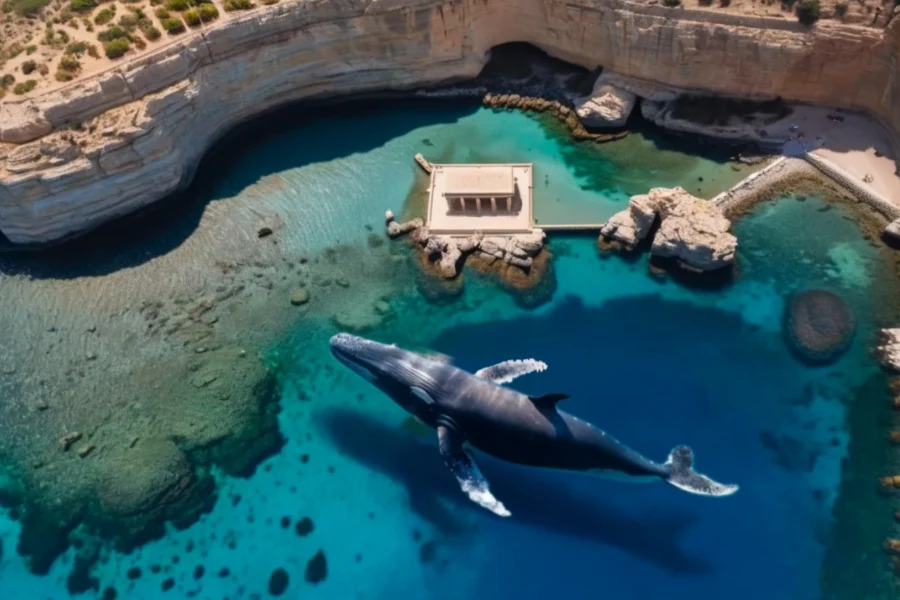
Perseus was flying over the coast when he saw a huge whale in the shallows and heard Andromeda’s cries for help.
As luck would have it, as this scene was unfolding, the mythical hero Perseus was returning home on the back of his flying horse Pegasus after having slayed Medusa, and, as he was flying over the coast, he noticed the dark silhouette of a huge whale in the shallows and Andromeda chained to a rock below. Not surprisingly, given her stunning looks, he instantly fell in love with her and agreed with Cepheus to take Andromeda as his wife after killing the sea monster and rescuing her. The two men vowed to keep the agreement, and Perseus, using the horrible petrifying power of the head of Medusa, killed the sea monster in time and freed Andromeda.
However, he had yet another fight to win. He had to fight with Phineas and his followers, who wanted to take Andromeda away from him. In the ensuing fight, he successfully turned them all to stone, but, sadly, the same fate awaited the royal couple. In the heat of the battle, Cepheus and Cassiopeia carelessly looked at the head of Medusa and were instantly turned to stone too. The myth ends with the happy marriage of Perseus and Andromeda and the transformation of Cepheus and Cassiopeia into constellations with the help of Goddess Athena.
An alternative version of the story is given by the mythographer Conon, of Coma Berecices fame. He wrote that Cepheus reigned over ancient Joppa (centered in modern-day Jafa in Israel), which extended from the Mediterranean Sea and northeast Africa to the mighty river Euphrates and the Arabian peninsula. The hero Phoenix and the king’s brother, Phineus, wanted to marry Andromeda. Cepheus had decided to give Andromeda to Phoenix but did not want to turn down Phineas explicitly, so he devised a plan and staged Andromeda’s abduction.
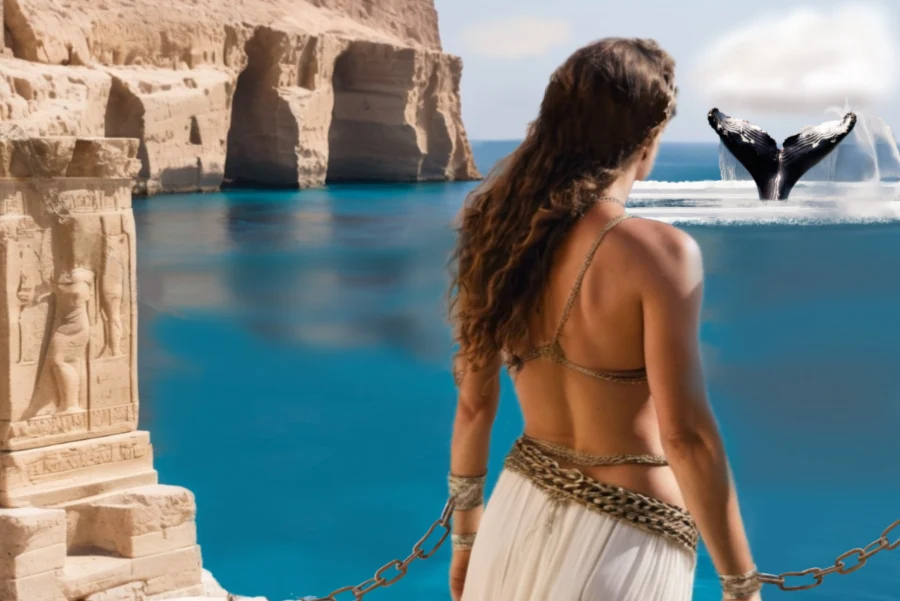
Andromeda was chained naked to the rocks on the rocky coast, waiting stoically for her fate.

In another version of the myth, Andromeda was abducted while visiting the temple of Aphrodite.
Andromeda used to visit an islet on the coast to offer sacrifices to the goddess of beauty, Aphrodite (Roman Venus). If everything went according to their well-prepared plan, Phoenix’s ship, Whale, would approach the islet, and Phoenix and his men would swiftly abduct Andromeda. The Gods had other plans, however.
The mythical hero Perseus, son of Zeus and Danae, was returning home on the back of Pegasus, the flying horse, after slaying Medusa with the help of Athena, and as he was flying over the coast, he saw Phoenix’s ship and heard Andromeda’s desperate cries for help. He swiftly descended, turned the startled men to stone, carried Andromeda away, and married her. After this tumultuous period in their lives, they reigned peacefully in the city of Tirynth, in south Greece.
Cepheus facts
location mapboasts an array of astronomical wonders. Stars such as VV Cephei and the Garnet Star, known for their colossal sizes, make their home here, contributing to the constellation’s allure. Alongside these giants, several deep sky objects, nestled within the borders of Cepheus, beckon astronomers and stargazing aficionados alike. As part of the Perseus family, it not only enriches the tapestry of the Milky Way stars but also serves as a gateway to exploring further celestial phenomena. This constellation, with its blend of mythological significance and astronomical marvels, invites us on a journey to unravel the mysteries that twinkle in our night sky.