INTRODUCTION
Key takeaways
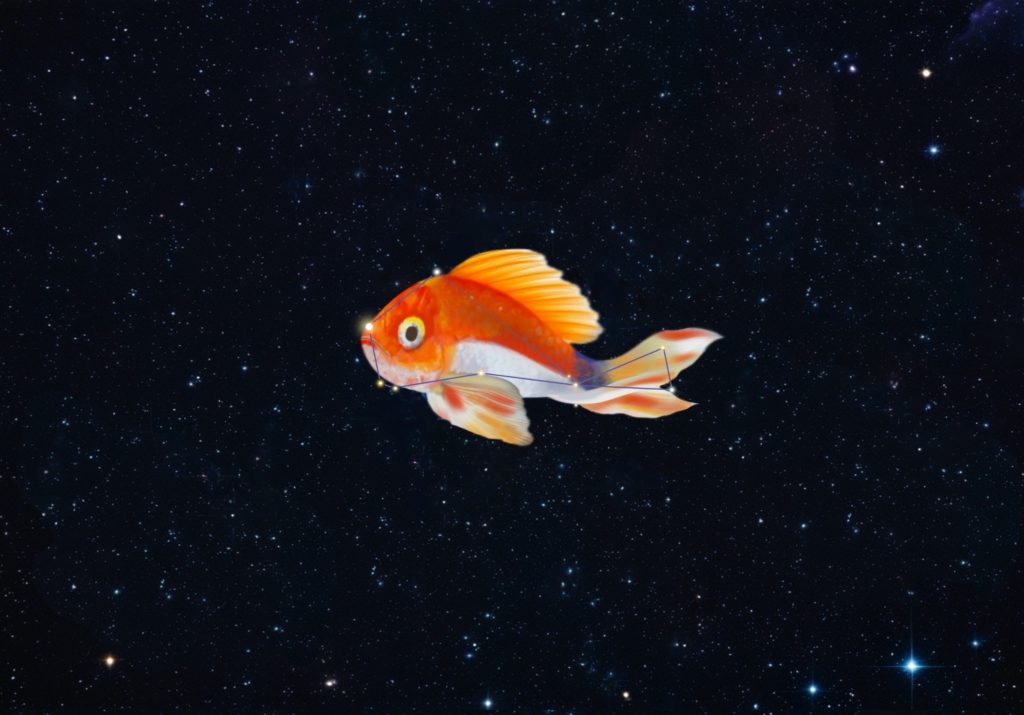
- Pisces Austrinus, the southern fish, is a small, dim constellation in the southern hemisphere.
- It is one of Ptolemy’s original 48 constellations.
- It represents one of the fish that Aphrodite and Eros transformed into.
- It contains the bright star Fomalhaut, the mouth of the fish.
STAR MAP OF PISCIS AUSTRINUS

When the most handsome mortal of his time, the Trojan prince Ganymede, was placed in the sky by Zeus, he did not stop being a water carrier. But while on Olympus, the water he carried brought refreshment to the gods; it plays a more vital role in the sky. For below the young prince flows an extraordinary river. The precious water flowing from his ceramic vessel must keep the river below him full and deep, especially since modern astronomers added the constellation Grus, a crane bird, to its banks.
The reason for taking his celestial duty far more seriously is that inside the river hides Eros, the god of love. Moreover, the careless placement of the constellation crane so close to its west bank makes the ample water supply from above even more crucial.
THE MYTH OF PISCES AUSTRINUS
Myth at a glance
Pisces Austrinus represents one of the two fish Aphrodite and Eros transformed themselves into to avoid the Titans.
Like fish, we have to dive deep into mythology to ascertain the origins of this small but prominent constellation. There, at the very bottom of mythology, we find the oldest piece of the puzzle. The story starts with the fight between the gods and the Titans.
The Titans were descendants of primordial deities that sprung from Chaos, the dominant force in the early universe. The union of Uranus (the sky) and Gaia (the earth) created the first twelve Titans. They were huge, powerful gods that engaged in an epic battle with the twelve Olympian gods. In the end, the Olympian gods prevailed.
But it was not an easy fight. While the fearsome goddess of war, Athena, and the god of war, Ares, could fearlessly confront the most powerful foe, other gods experienced great difficulty in this battle, the famed Titanomachy. Among them was the goddess who materialized from the sea foam on the idyllic shoreline of Paphos on the island of Cyprus. The goddess of love and beauty, Aphrodite.
Aphrodite was the daughter of Uranus, or, according to Homer, a daughter of Zeus. One of her many sons was the god of love, Eros. Usually depicted as a child with a bow, according to Hesiod, he was beside Nyx and Erebos, one of the three primordial forces who, knowing no birth or death, preceded even the gods. In his case, that force was unity, in the absence of which not even the gods could multiply. This is the reason he was present at his mother’s birth.
Together with the rest of the Olympian gods, Aphrodite and her son had to flee Olympus and seek refuge from the attacking Typhon (typhoon) in Egypt, where they assumed the form of animals. Typhon, son of Gaia and Tartarus, was the most fearsome creature in Greek mythology. His body was half human and half serpentine. His size was so colossal that he was taller than any mountain, his head almost touching the stars, and when he spread his hands, they extended from the east to the west.

Aphrodite and Eros tried to hide from Typhon in the Euphrates River.
To save themselves, mother and son transformed into fish.
Aphrodite and Eros, in an attempt to save themselves from this fire-breathing, viper-bodied monster, left Egypt and sought refuge on the lush banks of the Euphrates River. However, Typhon found them, and as a last desperate resort, they dove in panic into the river disguised as fish. In another version of the myth, the constellation represents the fish that guided the divine duo to a safe hideout. Forever grateful, the gods placed the savior fish among the stars.