
Stargazing Guide: Unveiling the Mysteries of the Water Bearer
INTRODUCTION
Key takeaways
- Aquarius is a dim zodiacal constellation in the southern hemisphere.
- It is one of Ptolemy’s original 48 constellations.
- It represents the ancient Greek youth, Ganymede.
- It contains three Messier objects.
- The brightest star’s name is Sadalsuud.
- It contains the famous meteor shower, Eta Aquarids.
STAR MAP OF AQUARIUS

As the dry, warm summer nights give way to the cooler and longer autumnal nights in the northern hemisphere, a new roast of constellations slowly replaces the showy ones that kept us in awe during the summer. These constellations, less rich in deep-sky objects and more subdued, as if seen through a layer of water, actually have an intrinsic relationship with the wet element. Central among this group, comprising wet constellations like the dolphin (Delphinus), the fish (Pisces and Pisces Austinus), the whale (Cetus), and the sea goat (Capricornus), is the constellation Aquarius. A young man pouring water from his water jar represents this constellation.
Aquarius myth
MYTH AT A GLANCE
Aquarius depicts either the Trojan prince, Ganymede, the King Deucalion, or Aristeus. Ganymede was the most handsome mortal, and Zeus abducted him and brought him to Olympus to serve as a cupbearer. After a brief stay, Ganymede was placed among the stars. Deucalion was a king and the son of Prometheus. When Zeus caused a cataclysm to end humanity, Deucalion and his wife were the sole survivors. Later, by following the advice of an oracle, they respawned the human race.
As is often the case with the constellations of antiquity, the mythology of Aquarius is a little vague but mainly revolves around the story of Ganymede. Ganymede’s family tree has more than one version. Some place him close to the time of the founding of Troy, and others place him much closer to the time of the Trojan War. A war where the Trojans had to suffer Hera’s wrath, which was fuelled by the abduction of the young man by her husband, Zeus. Likewise, the king of Crete, Minos, the son of Zeus Tantalus, or the goddess of the dawn, Eos, is occasionally blamed for kidnapping Ganymedes rather than Zeus.

Zeus sent his faithful eagle to carry Ganymedes to Olympus.
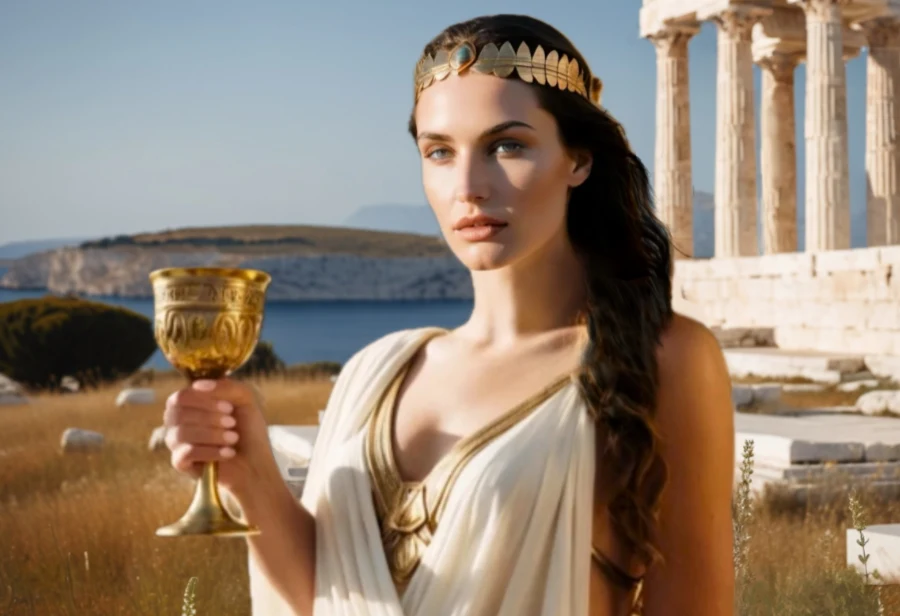
Hebe, the personification of eternal youth, was also the cup-bearer of the gods.
According to Homer, Ganymede was the son of King Tros and Queen Callirroe and the most handsome mortal. One day Ganymede was tending his father’s flocks in the lush mountains around Troy when Zeus noticed him. Ganymedes’s beauty caused such an impression on Zeus that he decided to bring him to Mount Olympus. Zeus either transformed into an eagle or sent an eagle to abduct Ganymedes and carry him to Olympus. There, granted immortality, his duty was to be the cup-carrier of the gods. Something that, until then, was the responsibility of the lovely young lady Hebe, the embodiment of eternal youth.
To lessen the grief of Ganymedes’s father, Troy, Zeus gifted him his famous horses. These horses, however, would become the cause of the death of a Trojan king. But Ganymede’s stay on Mount Olympus was brief. Succumbing to pressure from Hera and Hebe, who opposed his presence, Zeus picked the wettest spot in the sky and placed the handsome youth among the stars, transforming him into the constellation Aquarius. Near him, he placed the eagle as the constellation Aquilla. Thus was born one of the most popular themes in classical and Renaissance art: the abduction of Ganymede by Zeus.
Another myth connects Aquarius with Deucalion, son of the Titan Prometheus. He was the mythical progenitor of the Greeks, and he gave his name to the flood caused by Zeus’s anger against the impious Lucaon and his sons. Lucaon and his many sons angered Zeus by sacrificing a boy for him and committing other horrible deeds. Zeus turned them into wolves as a kind of punishment, and then, disgusted, he decided to end humankind by releasing a tremendous flood.
Prometheus, knowing the plans of Zeus, advised Deucalion to build a strong wooden vessel and stuff it with provisions. That would ensure the survival of Deucalion and his wife, Pyrrha. Soon after the completion of the vessel, terrible floods covered the entire world, save for a few mountain peaks. After nine agonizing days and nights, as the waters started subsiding, the ship came to rest on the top of Mount Parnassus, near Athens, in central Greece.
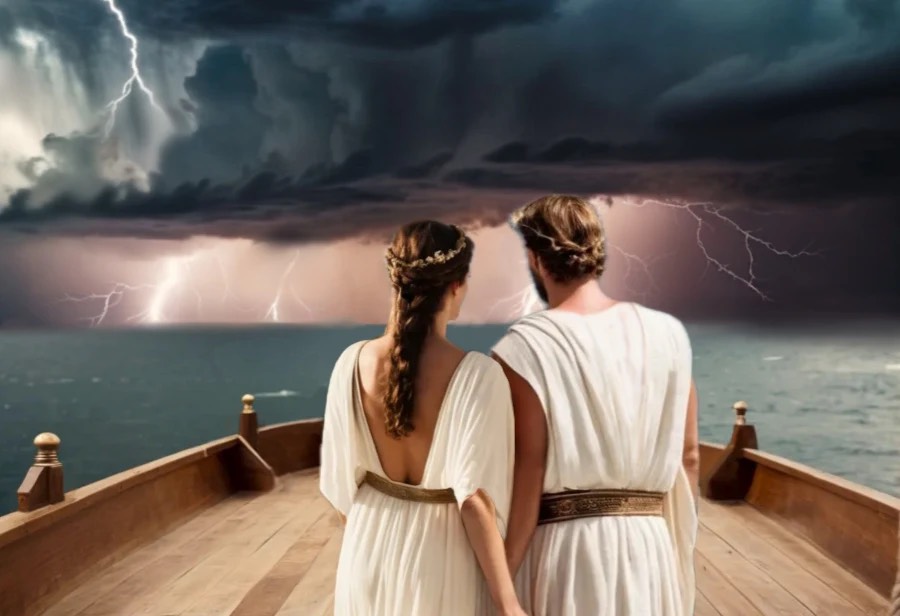
Deucalion and Pyrrha finished the construction of their ship just in time.
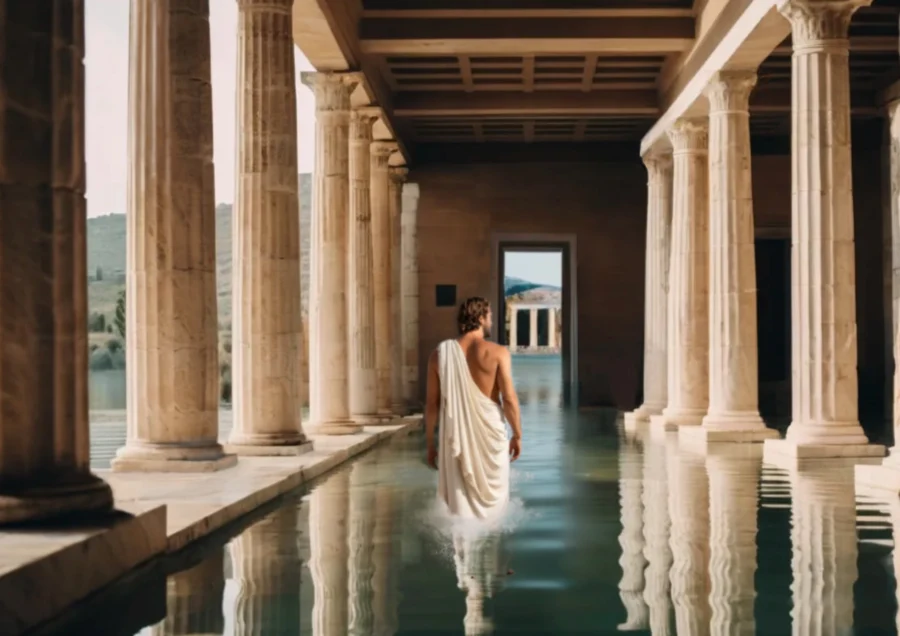
As the floodwaters were subsiding, Deucalion sought guidance from the oracle of the Titan Tethys.
There, Deucalion offered sacrifices to Zeus and wished for the reestablishment of the human race. This desire led them to consult the oracle of the Titan Themis, which cryptically advised them to shroud their heads and throw the bones of their mother behind them. Correctly interpreting the oracle, the couple covered their faces and walked, picking up rocks and throwing them over their shoulders. A man was born from every stone of Deucalion and a woman from the stones of Pyrrha.
A third myth connects the constellation Aquarius with the son of Apollo and Cyrene, Aristeus. Cyrene was the daughter of the king of Lapiths, the son of the river god Peneius, Hypseus, and the sister of Larissa and Ixion, the father of most centaurs. As the centaur Chiron, she lived on Pelion Mountain, a famous coastal mountain in central Greece, near the city of Larissa. She was passionate about hunting and was so skilled that she once subdued a lion that attacked her sheep in the foothills of Mount Pelion with her hands. Apollo witnessed that astonishing feat and, captivated by her, asked the centaur Chiron, who also lived on this mountain, about her identity.
Apollo, who was now aware of her identity and determined to take her for himself, kidnapped her while she was watching over her father’s flocks by the Peneius River. She took her to Lybia on a golden chariot driven by swans, established her as queen of the land, and near the modern-day Cyrene city, their son, Aristeus, was born. Aristeus grew up under the tutelage of the centaur Chiron and the Muses, and he turned into an exemplary youth, proficient in the arts of healing, prophesy, hunting, and beekeeping, among others. He would soon marry Autonoe and become the father of the ill-fated Actaeon.
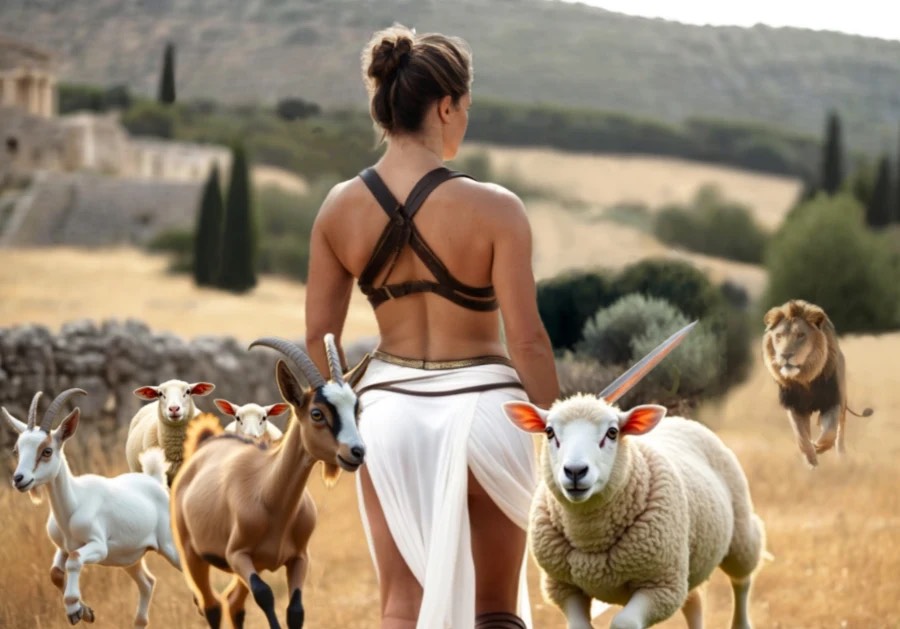
The princess Cyrene, a formidable huntress, was the mother of Aristeus.
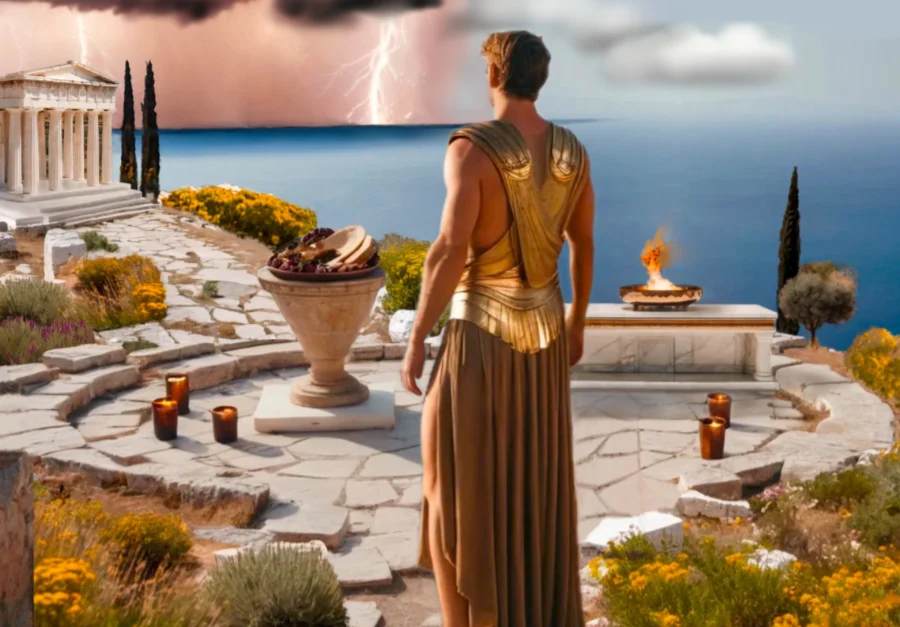
By following Apollo’s advice, Aristeus brought relief and rain during the scorching days of the dog star.
One summer, as the Aegean islands were plagued by famine and drought, Aristeus was advised by Apollo to visit the island of Kea, near Athens. There he found out that it was Sirius who caused the drought, because the murderers of Icarius, father of Irigone, were hiding among the inhabitants. The murderers were captured, and Aristeus erected an altar at the top of the island’s tallest hill, where he performed rituals and sacrifices to honor and appease the dog star, Sirius, and Zeus. He would do so at dawn, during the dog days of summer, a time of scorching heat coinciding with the concurrent rising of Sirius with the sun.
Zeus promptly brought relief to the land with refreshing summer breezes, the Etesian winds, and rain, which continue to this day in the Aegean Sea. Hence, many saw Aristeus in the stars of the constellation Aquarius instead of Ganymede or Deucallion. As for his mother, she gave her name to both the African city (Cyrene) and east Lybia (Cyrenaica), and visitors to the temple of Apollo in Cyrene, a UNESCO World Heritage Site, can still see and admire her. In front of the temple of Appollo, a stone sculpture shows Cyrene fighting a lion. Fittingly, the city’s port was named Appolonia.