introduction to The mythical winged horse
Key takeaways
- Perseus is a constellation in the northern hemisphere.
- It is one of Ptolemy’s original 48 constellations.
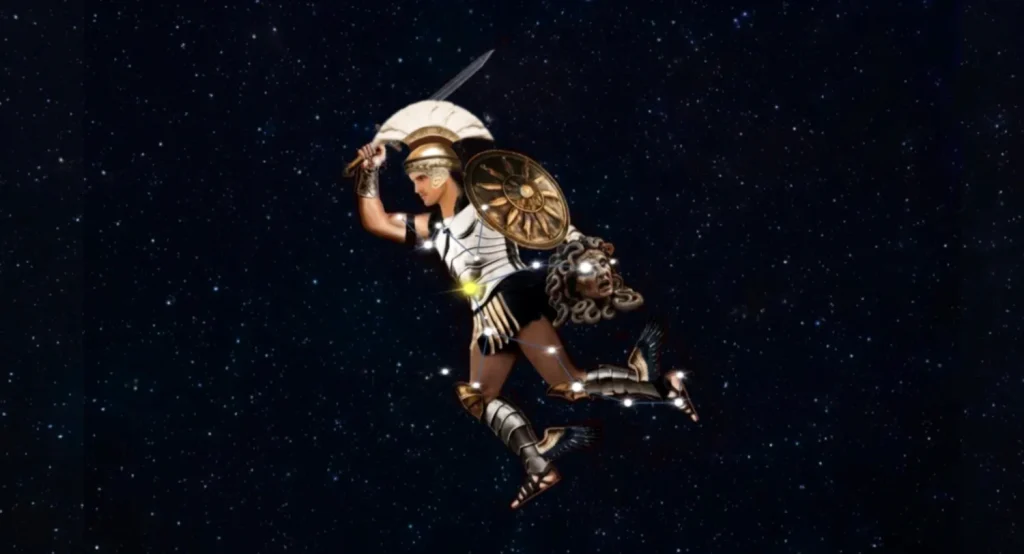
- It represents the legendary hero who saved Andromeda from Cetus.
- It contains one Messier object, the globular cluster M15.
- It contains the famous eclipsing binary, Algol, the Daemon Star.
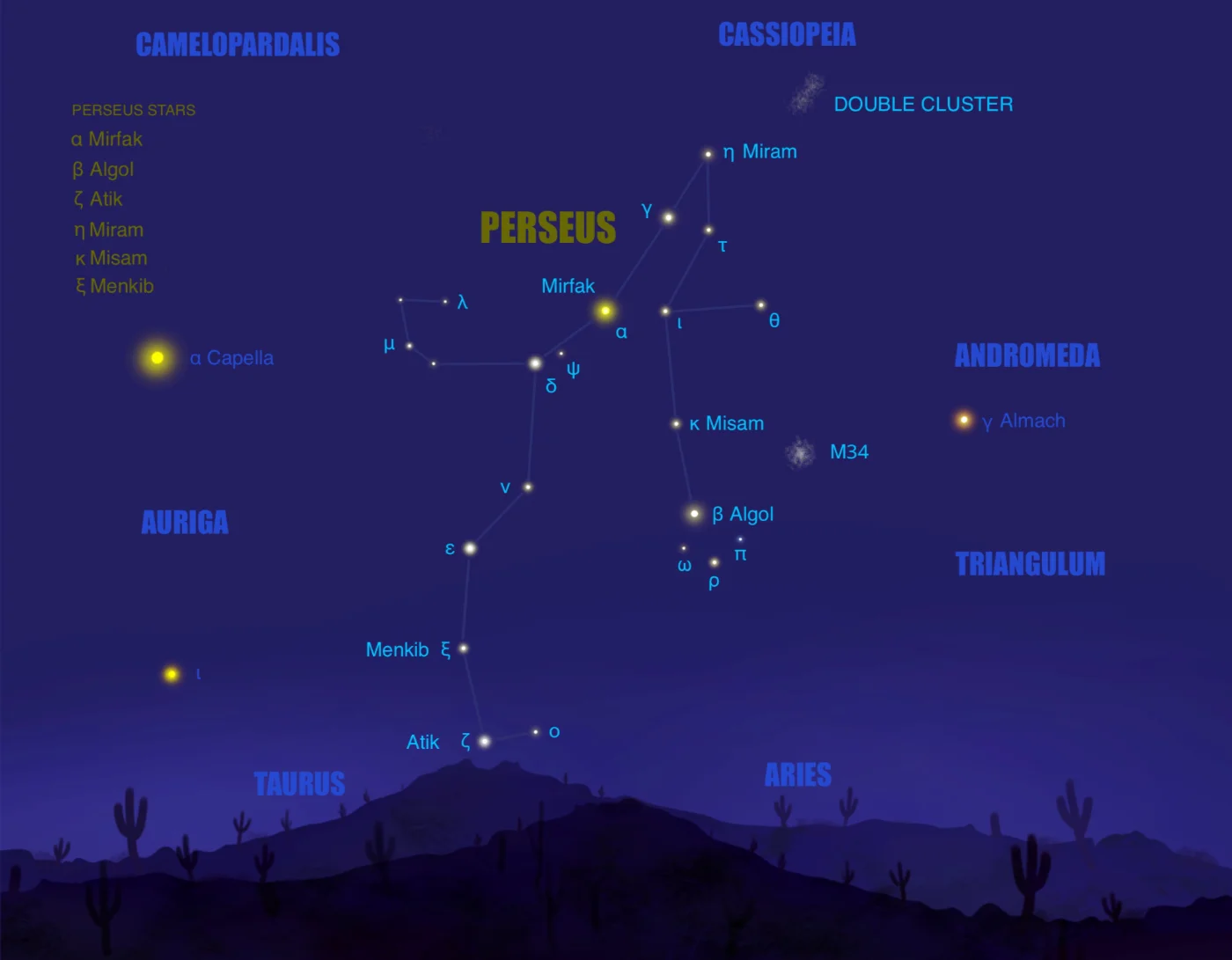
- The brightest star’s name is Mirfak.
Beginner’s map of PERSEUS
The Cygnus constellation pierces the northern sky with stunning clarity. Known affectionately as the Northern Cross, it has beckoned to astronomers, both amateur and professional, through the ages. Its brilliant stars, including Deneb, mark the corners of the Summer Triangle, guiding the eyes of night sky enthusiasts. Cygnus plays host to a mesmerizing array of deep-sky objects, from nebulae to supernova remnants. Beyond its celestial wonders, it carries the weight of mythology, narrating stories of gods and heroes, from Zeus and Leda to Orpheus and Phaethon. This constellation has also become a critical field in the quest for exoplanets, unveiling new worlds beyond our Solar System.
THE PERSEUS MYTH
THE MYTH AT A GLANCE
Perseus was tasked with killing the Gorgon Medusa, a hideous female creature. An impossible task that was only made possible with the help of two gods, Hermes and Athena. The moment Perseus slew Medusa, a winged horse, Pegasus sprung from her blood. Pegasus was later immortalized in the sky.
The myth of Perseus starts with Acrisius and Eurydike (or maybe Aganippe), king and queen of Argos, an eminent city in south Greece. Eurydike’s mother was Sparta, and her father was Zeus’s son. The royal couple only had one daughter, Danae, with whom the god Zeus fell in love. The days passed peacefully until one day, Acrisius asked an oracle if he would have a son and was told, “You will have no son, and your grandson will kill you.”
Desperate and hoping to avoid this fate, he imprisoned Danae in a heavily guarded dungeon. However, despite these precautions, Zeus entered the dungeon and united with her in the form of a shower of gold. Thus was born Perseus. Acrisius, outraged but hesitant to kill his own daughter, locked them in a wooden chest and cast it into the Aegean Sea.

Zeus fell in love with Danae, and he entered the dungeon in the form of golden rain.
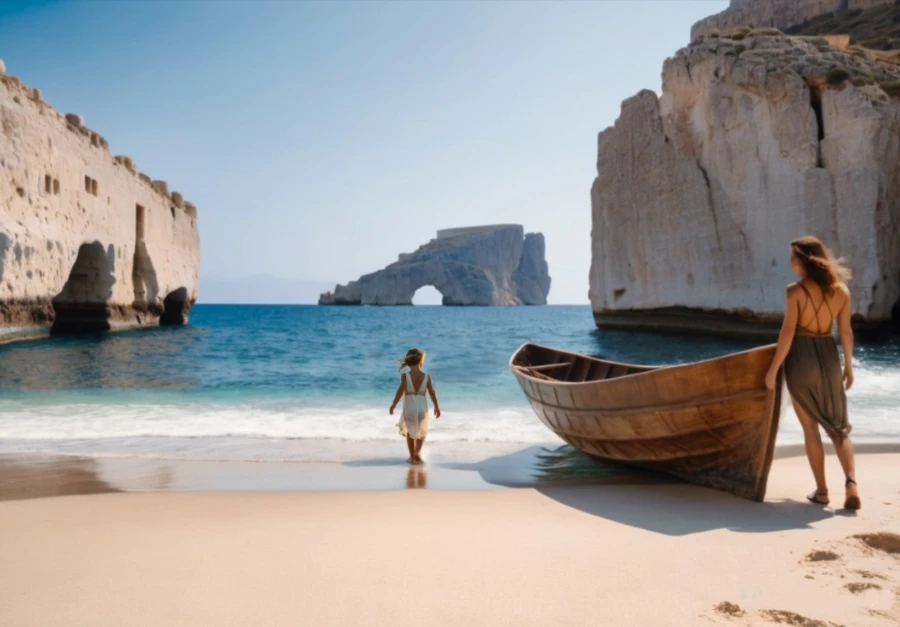
Danae and Perseus reached Seriphos, still alive inside the wooden chest.
However, the chest did not sink or crash on some rocky shore, as Acrisius had hoped. Near the island of Seriphos, a fisherman named Dictys netted the chest, and after hauling it ashore, he opened it. Danae and Perseus were still alive. He took them to his brother, the king Polydectes, and both helped with the rearing of Perseus.
The years passed, and Perseus became a beautiful, brave young man. An exemplary son, he was very protective of his mother, which was a source of frustration for Polydectes, who had repeatedly attempted to force marriage upon her. Wishing to get rid of Perseus, he devised a plan. Pretending that he would ask the hand of the daughter of King Oenomaus, famous for her beauty and greatly sought-after bride, Hippodameia, he asked each of his friends to contribute one horse as a gift.
Relieved that the king had finally turned his attention away from Danae, Perseus replied that he neither had a horse nor gold to buy one worthy of the occasion. “But I will try to bring you any gift you desire, even if it is Medusa’s head,” he assured the king. Acrisius instantly replied that he could not think of a better choice. His plan to get Perseus out of his way for good had worked. Or so he thought.
Medusa was one of the three Gorgons and the only mortal one. The other two were Stheno and Euryale. They were hideous female monsters, so terrifying that they invariably turned anyone who looked at them to stone. Medusa was particularly nightmarish. Her head, covered with dragon scales, was snake-haired; her mouth was armed with boar tusks; she had a long, protruding tongue; and could even fly using her golden wings.
Medusa was a priestess in one of the temples of Goddess Athena, but she committed a grave sin. Either she united with Poseidon inside the temple of the goddess, or she boasted that she was more beautiful than Athena. Hesitant to confront Poseidon, Athena unleashed her fury on Medusa alone and transformed her into that horrifying, snake-haired creature.
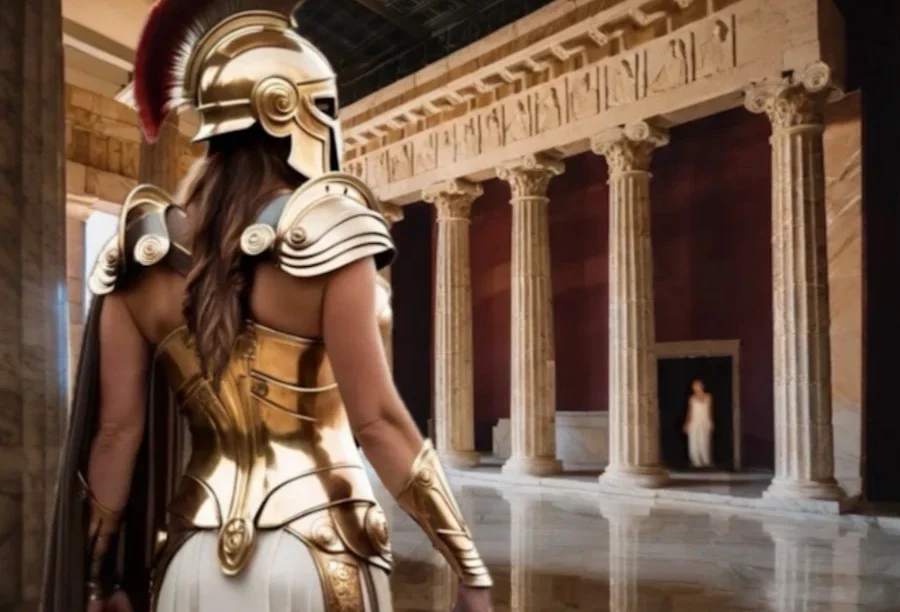
The frigid stare of Athena convinced Medusa that the goddess knew about her sin and that her punishment was imminent.
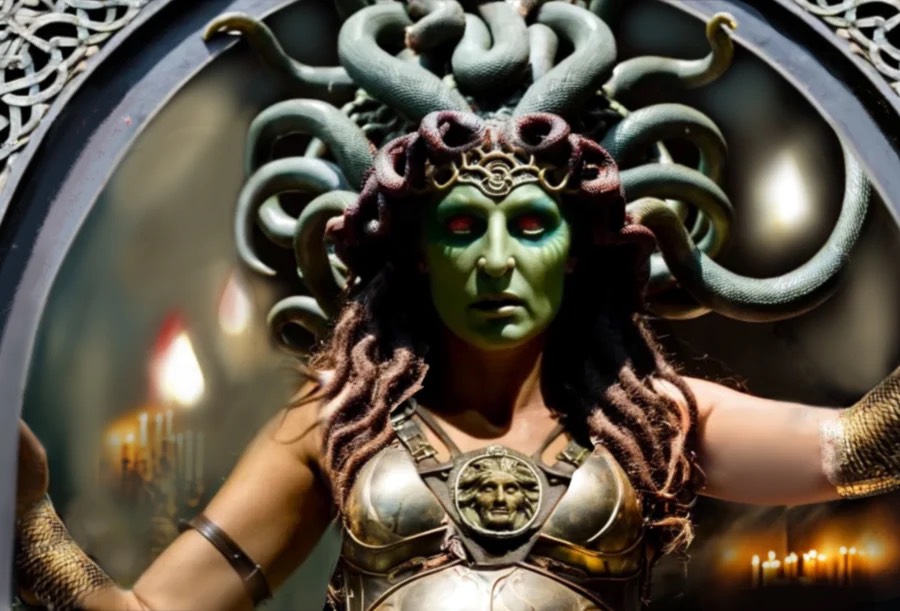
Athena transformed Medusa into a hideous monster that lived on an island, near the land of the Hesperides, at the western edge of the world.
Ancient writers gave us differing versions of their whereabouts. According to some, they lived near the springs of Oceanus. These were said to be located at the edges of Nyx and near the land of the Hesperides. According to others, they lived on the plains of Clisthene, in Ionia, Asia Minor, or somewhere near the mythical Lake Tritonis in Libya, the name given to North Africa.
Perseus set out on his quest, but not alone. Being a son of Zeus, he had the support of his father and, crucially, of the goddess of strategic warfare and wisdom, Athena, who accompanied him on his adventure. She gave him her polished, highly reflective shield and advised him not to look at Medusa directly, but only at her reflection.
Perseus also had the support of Hermes, who furnished him with a razor-sharp sickle and winged sandals. Armed with divine protection and following the instructions of Athena, Perseus visited the Stygian Nymphs and took from them a magic sack to safely contain Medusa’s head and the leather helmet of invisibility, which belonged to Hades. Fully equipped, he set off to the island of the gorgons.
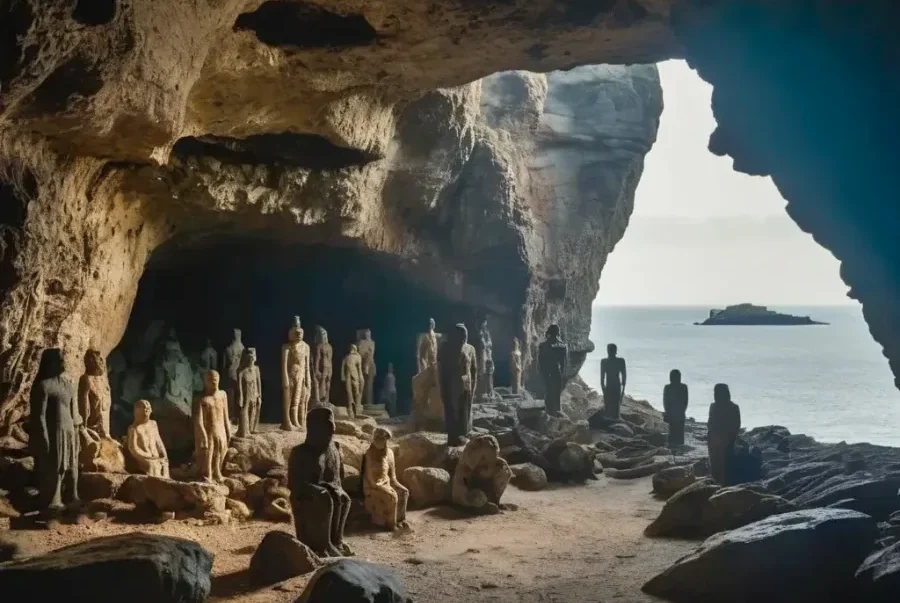
The grim spectacle of the cave’s entrance left Perseus with no doubt that he had found Medusa.
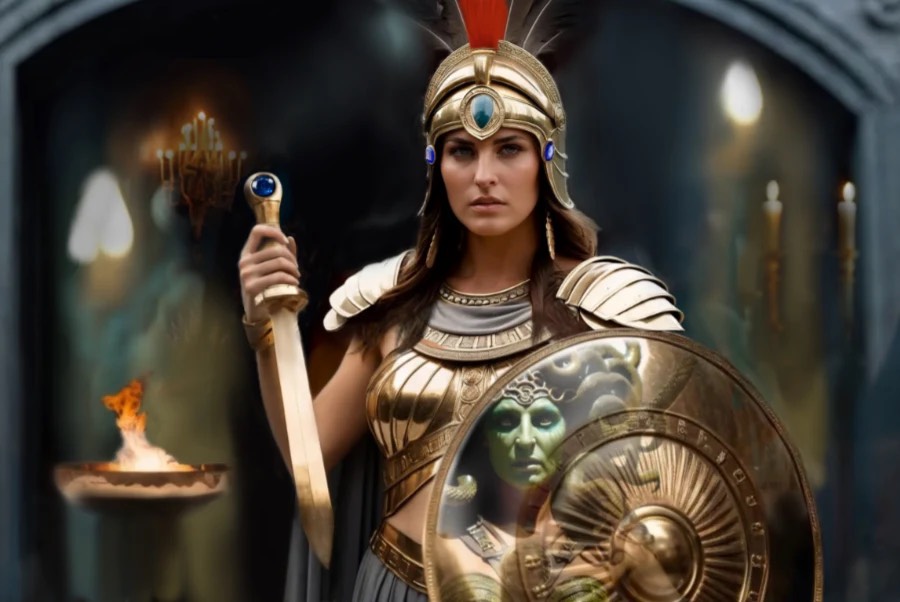
The reflective shield of Athena enabled Perseus to look at Medusa’s reflection.
Perseus found the cave of the Gorgons easily. A multitude of stone statues lay outside the entrance, the petrified remains of their victims. He cautiously approached the cave and found them sleeping inside. With Athena holding the shiny, very reflective shield, he could safely look at their reflection and approach them. With his gaze fixed on Medusa’s reflection and Athena guiding his hand, he cut Medusa’s head with one stroke of Hermes’ sickle.
To his surprise, as soon as her blood spilled on the floor, the winged horse Pegasus and the warrior Chrysaor sprung from it. All this noise woke up Stheno and Euryale, and they flew after him as he hurriedly put the head in his sack and escaped wearing the helm of invisibility.
Perseus spent the rest of the day flying, and the sunset found him over the palace of the Titan Atlas. Perseus descended, but he was unwelcome because Atlas was once advised by an oracle of Thetis on Parnassus Mountain that a son of Zeus would steal the apples of his extensive apple orchards. Perseus, as a punishment for his inhospitality, petrified Atlas, turning him into the Atlas mountain. The next day, he flew eastward over the Lybian desert, and after a brief stop in Egypt, he kept following the coastline.
He was flying over the coast of Phoenicia, at that time part of ancient Aethiopia, when he noticed a huge whale in the shallows and a naked woman chained to the rocky shore. She was none other than Princess Andromeda, the daughter of King Cepheus, over whose kingdom he was flying. Her legendary beauty captivated him, and he instantly fell in love with her.
Andromeda’s mother was Queen Cassiopeia, who had recently carelessly boasted that she and her daughter were more beautiful than even the sea nymphs, the elusive Nereids. Poseidon could not let such an insult go unpunished and unleashed a series of devastating floods on the kingdom.
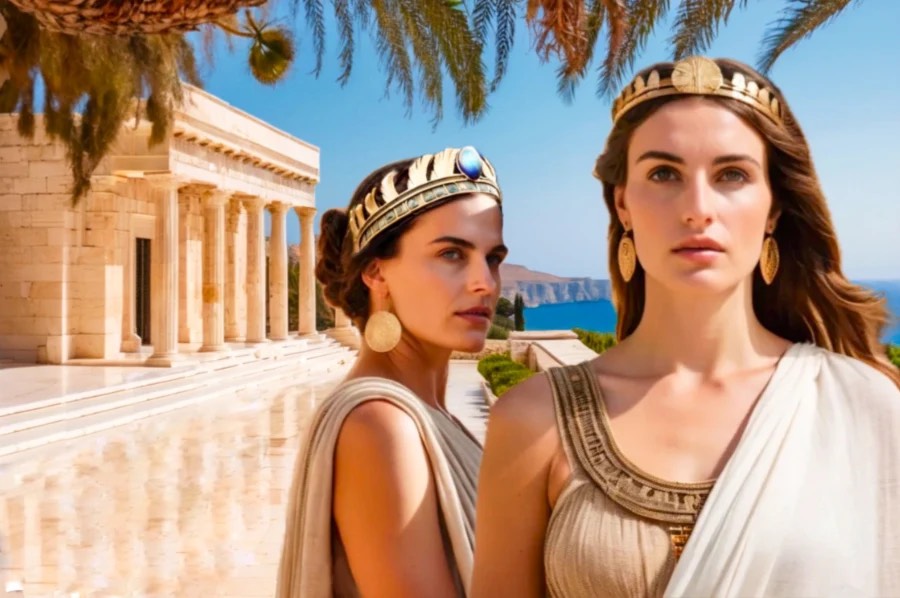
Cassiopeia had boasted that she and Andromeda were more beautiful than the Nereids.
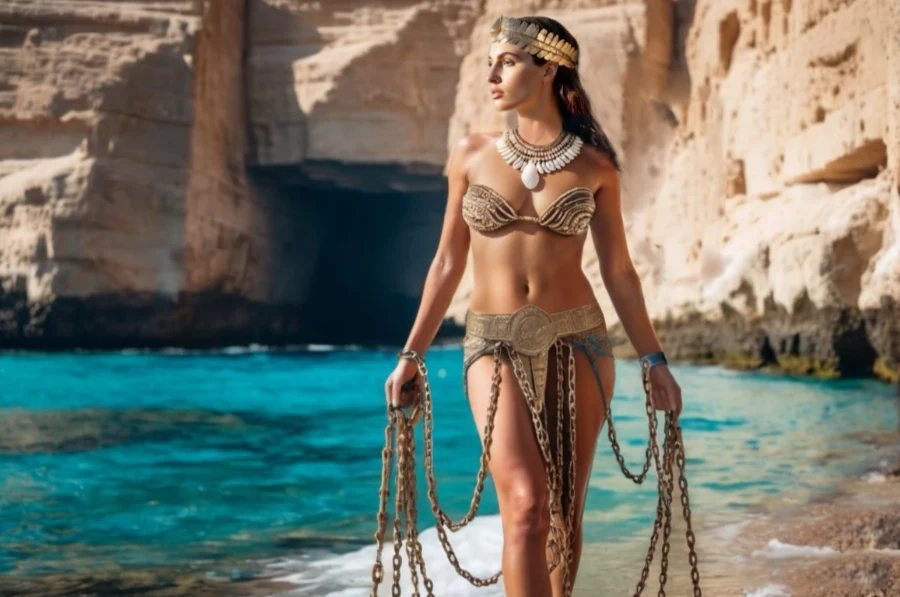
Andromeda was chained to the rocks and left naked and helpless to be devoured by the sea monster.
A powerless and desperate Cepheus consulted the oracle of Ammon, where he was told that the only way to save Aethiopia would be to sacrifice Andromeda to a sea monster. Although he tried to keep the oracle a secret, his people eventually discovered it. They obligated him to leave Andromeda, naked and chained to the salty rocks of ancient Iope, present-day Haifa, Isreal, to be devoured by a monstrous whale.
Perseus was approaching Andromeda when he noticed her anxious parents nearby and had Cepheus promise to give him his daughter if he could save her. Cepheus had no choice, and Perseus, armed with the petrifying power of Medusa’s head, killed the monstrous whale and saved Andromeda. In that location, near the coast, there once was a spring with reddish water. The legend goes that the color of the water originated when Perseus washed his hands to remove Medusa’s blood.
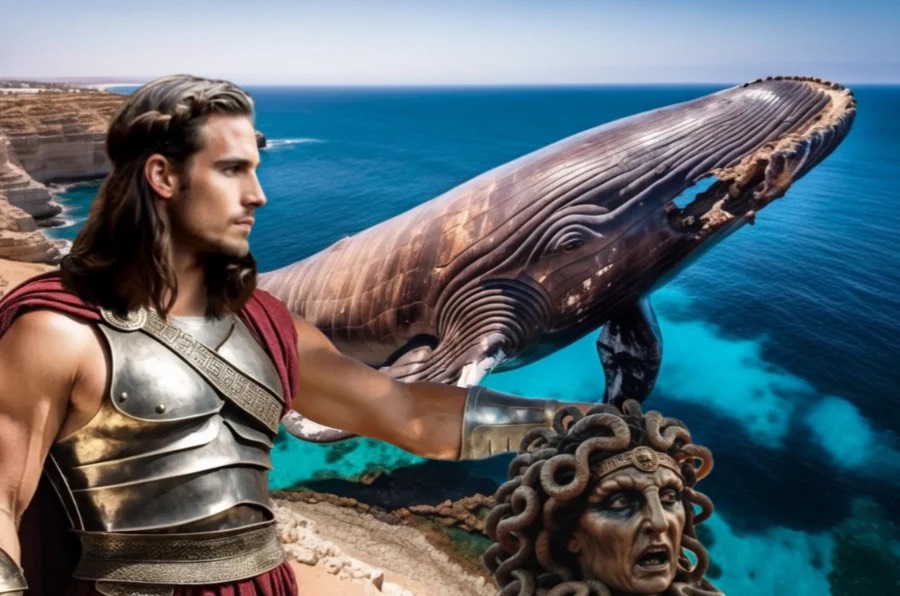
Cassiopeia had boasted that she and Andromeda were more beautiful than the Nereids.
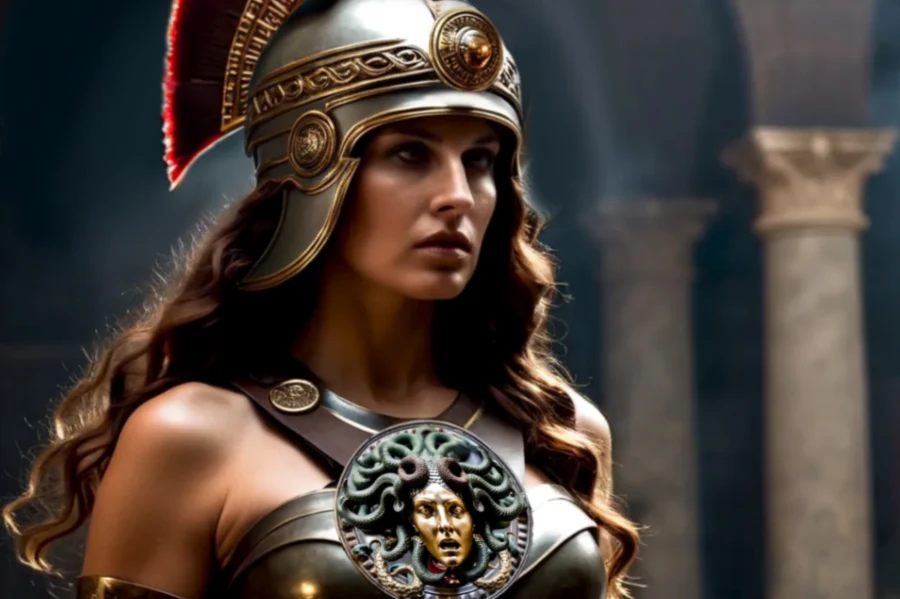
Andromeda was chained to the rocks and left naked and helpless to be devoured by the sea monster.
Soon after, Perseus and Andromeda were married, but Phineus (the brother of Cepheus) and his men attempted to stop the marriage. Initially, Cepheus had promised Andromeda to Phineus, who, aided by his men, tried to kill Perseus. The hero, greatly outnumbered, had to resort to his ultimate weapon, Medusa’s head. He petrified his enemies and, unfortunately, the royal couple, who happened to look at Medusa’s head during the mayhem. Nevertheless, Andromeda married Perseus, and they returned to the island of Seriphos, where he found his mother, Danae, hiding from Polydectes in a temple.
Realizing that Polydectes had deceived them and that he would never leave them in peace, Perseus went straight to his palace, eager to offer him the promised gift. Before Polydectes and his men could react, he turned them all to stone. His next move was to put Dictes on the throne and offer the head of Medusa to Athena, who fixed it on her chest. Then he gave Hermes the winged sandals, the magic sack, and the helmet of Hades, which he returned to the Stygian nymphs.
The time came for Perseus to return to Argos. They set sail, and after a few days, they reached the city of his grandfather, who, notified of their return, fled to the city of Larissa, in Thessaly, central Greece. However, he could not escape fate because Perseus happened to visit the city to compete in the local games, held to honor the dead father of the city’s king. That day, Acrisius happened to be among the crowds watching the games. Perseus participated in the pentathlon and, while competing in the discus throw, accidentally killed Acrisius, as the discus mysteriously veered off course and fatally wounded him. However, being responsible for the death of the king of Argos, Acrisius, Perseus chose to reign in neighboring Tirynth instead of Argos.
Perseus and Andromeda had many children, the first of which, a boy named Perses, was born before the couple’s return to Greece from Aethiopia. Perses was raised in Aethiopia and grew up to become the father of Achaemenes, the legendary ancestor of the Achaemenids, the kings of Persia. It is even said that Xerxes asked the cities of Argos and Thebes not to take the side of the rest of the Greeks in the upcoming war, reminding them of their common ancestry. While in Greece, Perseus and Andromeda were blessed with many children, one of which was Alkaios, the grandfather of Hercules.
Perseus founded the eminent city of Mycenae, a Unesco World Heritage Site that reached its apex around 1400 BC. Visitors can still see, among other attractions, the tomb of Clytaemnestra (sister of Castor, Pollux, and Hellen of Troy) and the spring of Perseus. The spring lies about 450 meters east of the Acropolis walls and a little higher. Its water first sprung forth when Perseus picked up a mushroom to quench his thirst in the arid, rocky landscape and was later used to irrigate the city. The remains of a fountain called the Fountain of Perseus can also be seen a short distance west of the impressive lion gate. Perseus was placed among the stars near Andromeda.