
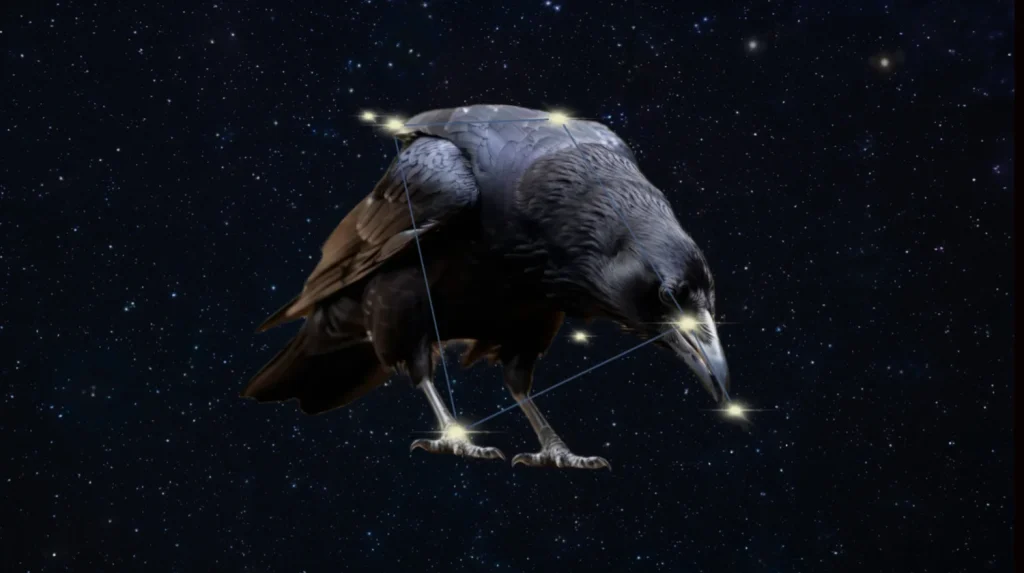
Stargazing Guide: Unveiling the Mysteries of the mythical
INTRODUCTION
Key takeaways
- Corvus is a small, dim constellation in the southern hemisphere.
- It is one of Ptolemy’s original 48 constellations.
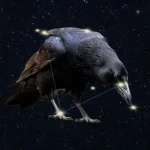
- It represents the raven.
- It contains
- The brightest star’s name is Alkes.
Beginner’s map of CORVUS

The huge Cygnus and neighboring Aquila constellations, which form a dominant avian duo in the summer sky, are not the only feathered celestial denizens. Privileged by their sheer size, abundance of bright stars, and placement high in the sky, they get the bulk of the attention from sky-watching ornithologists.
However, other birds have also managed to secure that most glamorous of honors: a place among the stars. One of them, although obscure in the sky, is a showstopper on earth. It’s Tucana, the toucan. In contrast, another one, the raven, is obscure in every conceivable way. Its black plumage, combined with its small, dim figure, brief stay above the horizon, and placement low in the misty sky for northern hemisphere observers, conspire to make him one of the most elusive constellations.
Consisting of only very few and mostly dim stars and comprising a tiny part of the sky devoid of bright deep-sky objects, it has one saving grace: its placement in the sky by none other than the god Apollo himself. So grab your telescope, binoculars, and birdwatching logbook, and let’s explore the wonders of the mythological raven.
Corvus constellation myth
Myth at a glance
Corvus represents .
A convenient starting point in the story of Corvus is the birth of the beautiful Coronis. She was the daughter of the Lapith king of Orchomenos, a city in central Greece, Phlegyas. She was so attractive that Apollo, the god of light, one day entered the palace and abducted her against her will. They united in the foothills of Mount Pelion, but, nearby, her father, furious by Apollo’s insult, summoned his men and marched against Delphi, where they inflicted serious damage to the holy shrines and temple of the god. Very soon, though, they got a taste of Apollo’s revenge. Apollo killed everybody, including the father of his new-found lover, the king Phlegyas.
Coronis, afraid that Apollo would abandon her and succumbing to lust, recklessly slept with an Arcadian shepherd named Ischys while still pregnant. Cheating a god with a mortal was unheard of. The outcome of such a grave sin could only be dark, but there was a silver lining at the end. Ischys may have gained eternal fame as the mortal who seduced the lover of a god but did not escape punishment. Apollo killed the shepherd and tasked his sister, Artemis, with taking the life of Coronis. Despising mortals who can’t resist material and earthly pleasures, Artemis, a virgin goddess like Athena, killed Coronis with her golden arrows.
Apollo, in his rage, had forgotten about his son, and only at the last moment did he remove him from the body of Coronis at the funeral pyre. He would be given by the god to Chiron, entrusting his upbringing to the wise centaur. The infant, born amidst such catastrophe, would grow up to become the god of medicine, Asclepius.

The love affair of Coronis with the shepherd did not escape the watchful eye of Apollo’s raven.
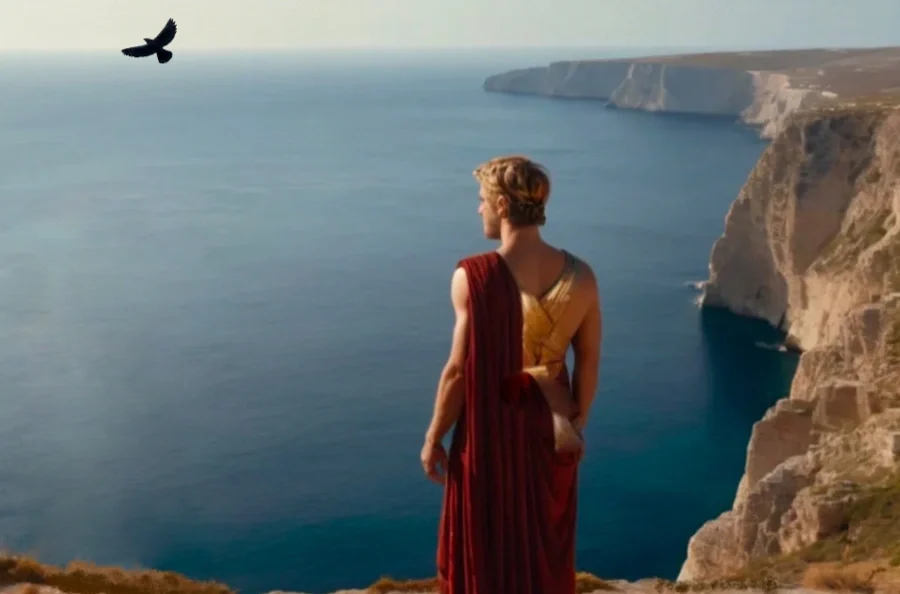
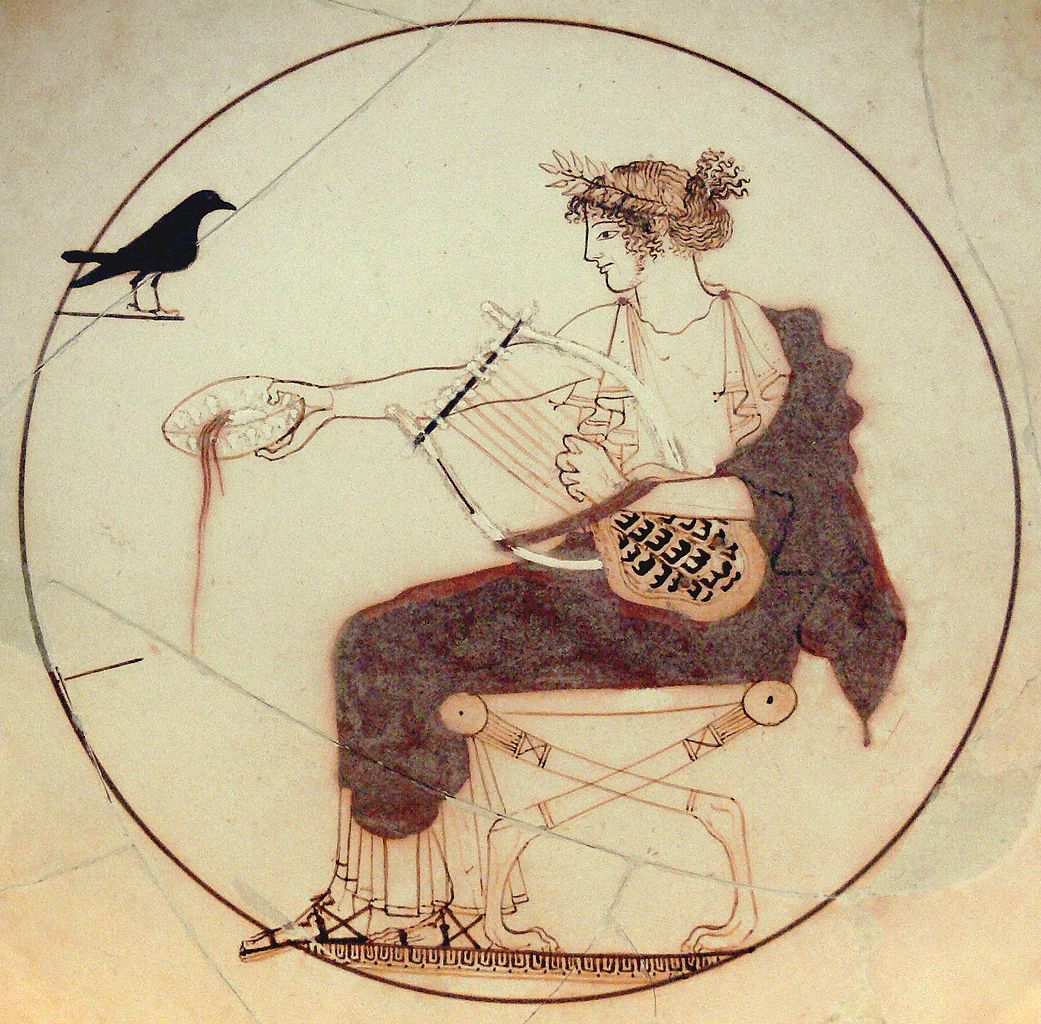
Apollo banished the raven and condemned him to have black plumage and a raucous call.
As for Corvus, it is the raven whom the god of light tasked with monitoring Coronis. The unfortunate bird was the first to bring the horrible news to Apollo, who, in his anger, turned its plumage black and removed any melody from its voice.
A second myth involving Corvus and Apollo is the following: once, Apollo gave a raven a jug and asked him to fill it with water and bring it back to him. The raven found a suitable spring, where a fig tree laden with semi-ripe, tasty-looking figs happened to grow. Succumbing to temptation, he decided to wait for the first of them to be fully ripe. Finally, with a belly full of figs, carrying a jar full of water, and struggling in the Sirius-induced mid-summer heat, he returned hurriedly.

The raven decided to wait for the full ripening of the tasty-looking figs.
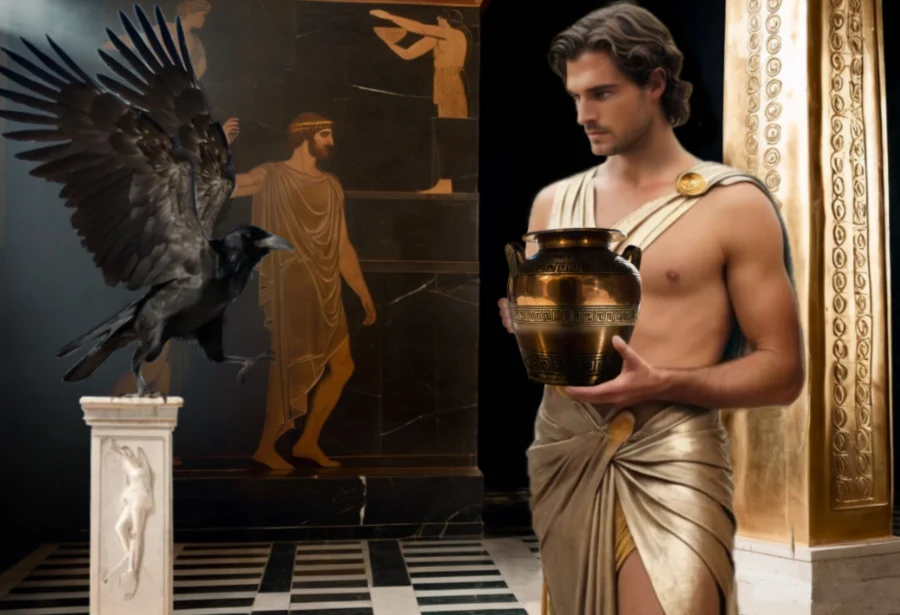
Ultimately, the raven fulfilled Apollo’s desire, but it was too late.
However, he knew he had to devise a credible excuse to justify his delay. So he found a water snake and did his best to convincingly describe to the angry god how difficult it was to bring water when this snake, every day, kept drinking all the spring water. Disgusted by the raven’s behavior, in a fit of anger, Apollo punished him, and to make an example of him that humans will never forget, he placed the crow, the snake, and the jug in the sky as the constellations Corvus, Crater, and Hydra. Millennia later, Coronis joined them as asteroid 15, Koronis.
Δύο εκδοχές αναφέρονται ως πιθανές για την αιτία της αλλαγής του χρώματος του κόρακα από άσπρο σε μαύρο. (Εικ. 1280)
1. Πρώτος ανήγγειλε στον Απόλλωνα τον γάμο της αγαπημένης του Κορωνίδας, κόρης του Φλεγύα, με τον Αλκυονέα
2. Πρώτος ανήγγειλε στον Απόλλωνα ότι ο Δίας είχε κατακεραυνώσει τον Ασκληπιό, τον γιο που είχε αποκτήσει από την Κορωνίδα ή από την Αρσινόη, κόρη του Λεύκιππου. η κορωνιδα που μεταμορφωθηκε σε κουρουνα ηταν κορ του λκορωνεα προστ της αθηνασ,την εκανε κουρουνα για να γλυτωσει απο την ερωτικη καταδιωξ τποθ ποσειφωνα



Hi, this is a comment.
To get started with moderating, editing, and deleting comments, please visit the Comments screen in the dashboard.
Commenter avatars come from Gravatar.