INTRODUCTION
Key takeaways
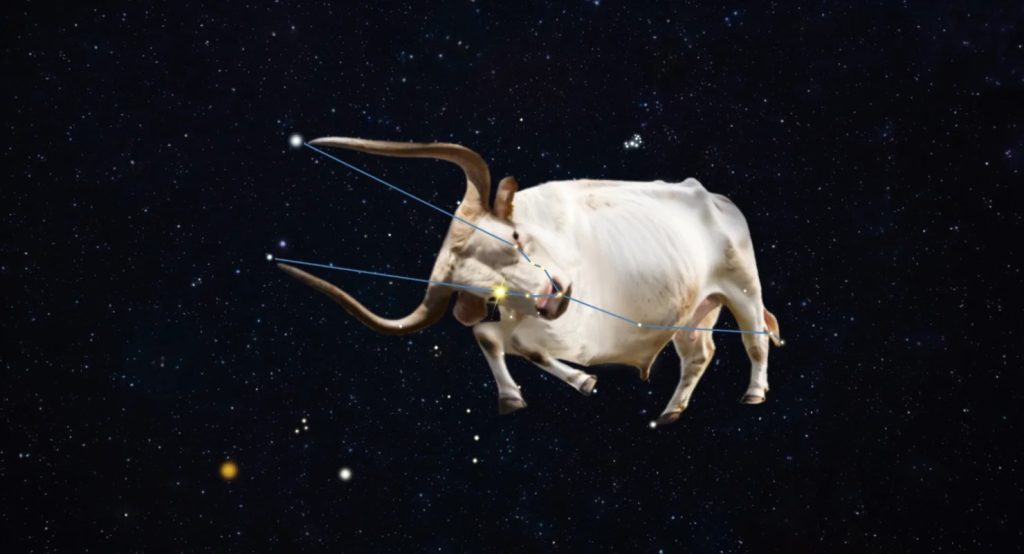
- Taurus is a bright zodiacal constellation in the northern hemisphere.
- It is one of Ptolemy’s original 48 constellations.
- It represents the bull that carried off Europa.
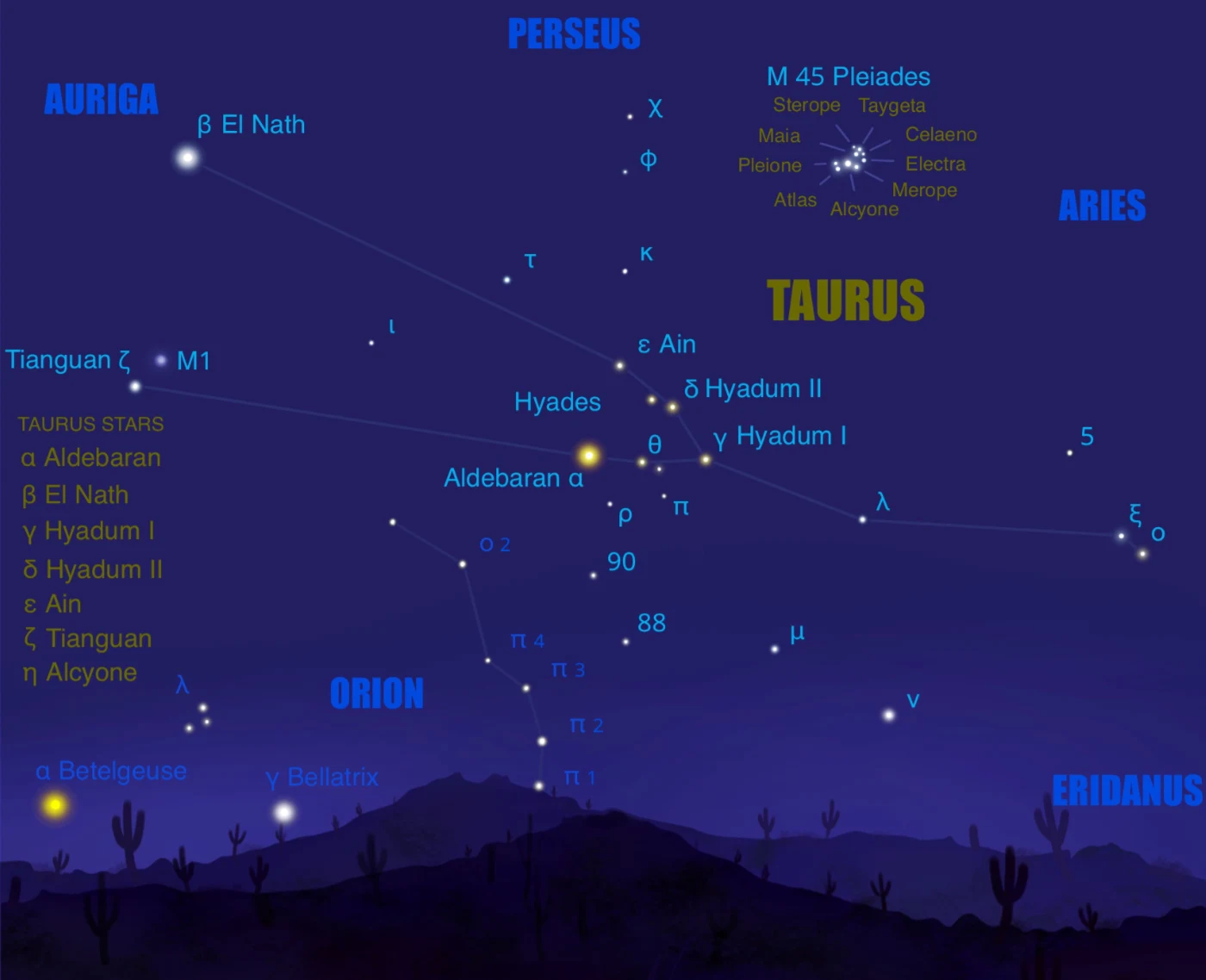
- It contains the brightest and closest open clusters, Pleiades, and Hyades.
- It contains the first Messier object, M1, the brightest supernova remnant.
- The brightest star’s name is Aldebaran.
- It contains the famous meteor shower, Taurids.
Beginner’s map of TAURUS
…
THE MYTH OF TAURUS
Myth at a glance
There are two versions of the myth of Taurus. In the first, Taurus was the white bull that Zeus transformed into to abduct the beautiful princess Europa. In the second, it represents Io, a priestess of Hera. Zeus, captivated by her beauty, united with her, and to shield her from Hera’s wrath, he cloaked her in a heifer’s guise. In both cases, Zeus put them among the stars.
Key participants and setting of the myth
- Europa: the beautiful daughter of Agenor and Telefassa, a royal couple from Phoenicia.
- Phoenicia: ancient name of the area around present-day Israel.
- Zeus: the king of the ancient Greek gods
- Mount Ida on Crete: a very tall mountain on the Greek island of Crete, where a cave called “Idaion andron” is believed to be the birthplace of Zeus.
- Io: a beautiful priestess at the temple of Hera (wife of Zeus) in Argos and a lover of Zeus.
- Argos: a city in southern Greece, the grandfather of Io, the guard of Io.
- Temple of Hera.
- Mount Silphium
- Iopolis
The myth of the constellation Taurus is tied to the island of Crete in the south Aegean Sea. The most famous of various myths involving Taurus is based on the story of the beautiful young woman Europa.
Europa was the daughter of the king of Phoenicia, Agenor, and his queen, Telefassa. She had five brothers, all important figures of antiquity. Cadmus, Phoenix, Kilix, Thasos, and Phineus. According to the myth, one beautiful day, Europa was walking in a blooming meadow, picking wildflowers by the seashore on the coast of Tire or Sidon. Zeus happened to see her and, impressed by her beauty, fell in love with her and immediately devised a plan to abduct her.
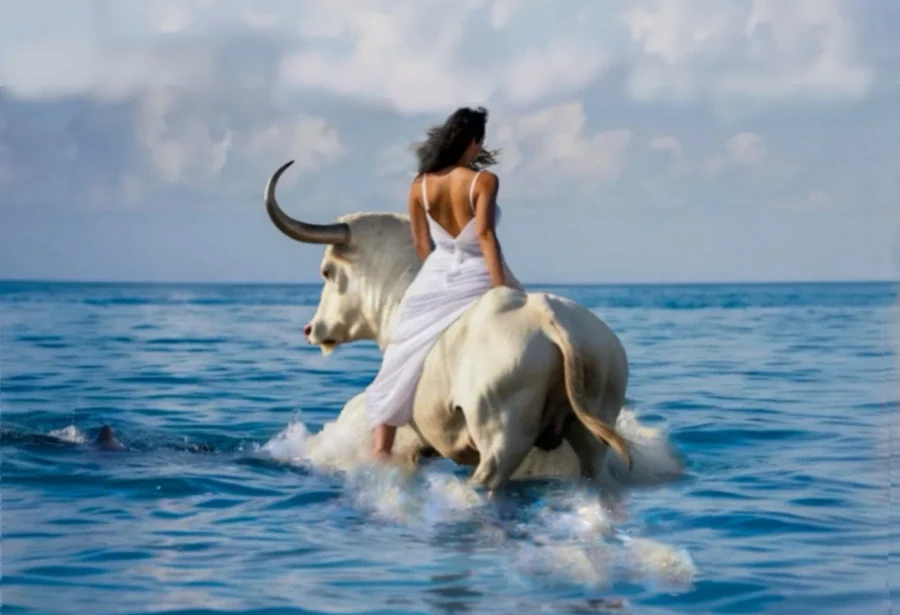
Zeus disguised himself as a majestic snow-white bull with glistening horns that gracefully galloped through the meadows. Its beauty struck Europa, who, surprisingly, found him gentle as a lamb. Before long, Europa could play with and feed him, and, as her confidence increased, she impulsively climbed onto his back.

The vanity of Queen Cassiopeia was the cause of tragedy for Cepheus and his Aethiopian kingdom.
The arrogance and vanity of Cassiopeia offended the beautiful Nereids and their father, Poseidon.
The moment that happened, suddenly Taurus rushed into the sea and swam away. Europa could only look back at the receding shore in terror as Poseidon, Tritons, Nereids, dolphins, and other sea creatures accompanied the bull as he swam to the island of Crete, carrying her on his back.
Wading ashore near Gortyna, Taurus revealed his identity to her. They united in the birthplace of Zeus, a sacred cave high on the mountain Dicte, or in a willow thicket, by the spring of Gortyna, under plane trees that have remained evergreen since, and had three sons: Radamantys, Sarpedon, and Minos.
Interestingly, Taurus contains the magnificent star clusters Pleiades and Hyades. Pleione, one of the stars of the asterism of Pleiades, was the daughter of Oceanus (the ocean), wife of Atlas, and mother of the Pleiades and Hyades. The mighty hunter Orion, who lies very close in the sky and appears to be fighting Taurus, chased them for five years before Zeus, out of pity, placed them among the stars. Although situated very near Orion, apparently they are safe under the protection of Zeus, the bull.
A second version of the myth of Taurus involves the beautiful priestess Io. Mythology connects Io with the Peloponnesian cities of Argos and nearby Corinth. In the former case, she is the daughter of the river god Inachus (and granddaughter of Oceanus) and Melia, or Iasos (son of Argos and Ismene) and Lefkanis. Inachus, the first to build a temple to the goddess Hera, was the first mythical king of Argos, a contemporary of Erichthonius who represents the constellation Auriga. In the latter, she is the daughter of Pirenas, the brother of Bellerophon. Sometimes she is also considered the daughter of Prometheus.
The vanity of Queen Cassiopeia was the cause of tragedy for Cepheus and his Aethiopian kingdom.

The arrogance and vanity of Cassiopeia offended the beautiful Nereids and their father, Poseidon.
Io was a beautiful priestess in the world-renowned temple of Hera (Zeus’s wife), the epicenter of her worship in Greece, at Argos, who caught the attention of Zeus. Every night, the same persistent dream tormented her. Voices were urging her to go to the pastures of Lake Lerna, accept the divine love of Zeus, and unite with him. Initially, she did not give much attention to the dream, but in the end, its persistence led her to say everything to her father. Her father, perplexed, sought the counsel of the oracles of Delphi and Dodona. The words were ominous and advised the banishment of Io from Argos; otherwise, the royal house would be destroyed by Zeus.
The vanity of Queen Cassiopeia was the cause of tragedy for Cepheus and his Aethiopian kingdom.

The arrogance and vanity of Cassiopeia offended the beautiful Nereids and their father, Poseidon.
Inachus reluctantly banished Io from the city, and she eventually united with Zeus. However, Hera immediately notices the union, and to protect the beautiful priestess from his wife, Zeus transforms Io into a beautiful white cow. (Another version of the myth has Hera transforming her priestess into a cow, assigning her monitoring to Argos, and causing a great drought after Zeus and Hermes came to Argos to visit Io.) The cow was so captivating that Hera wished she was dedicated to her. Zeus gave in and offered Io to Hera. Belonging to Hera, Io roamed the land free, always under the watchful eye of her guard and Hera’s servant, Argos Panoptes. Argos Panoptes, whose name means “all-seeing,” was a monstrous giant with 100 eyes that only half of them closed at night. To be with Io, Zeus had to take on the shape of a bull, and he ultimately asked Hermes to kill Argos.
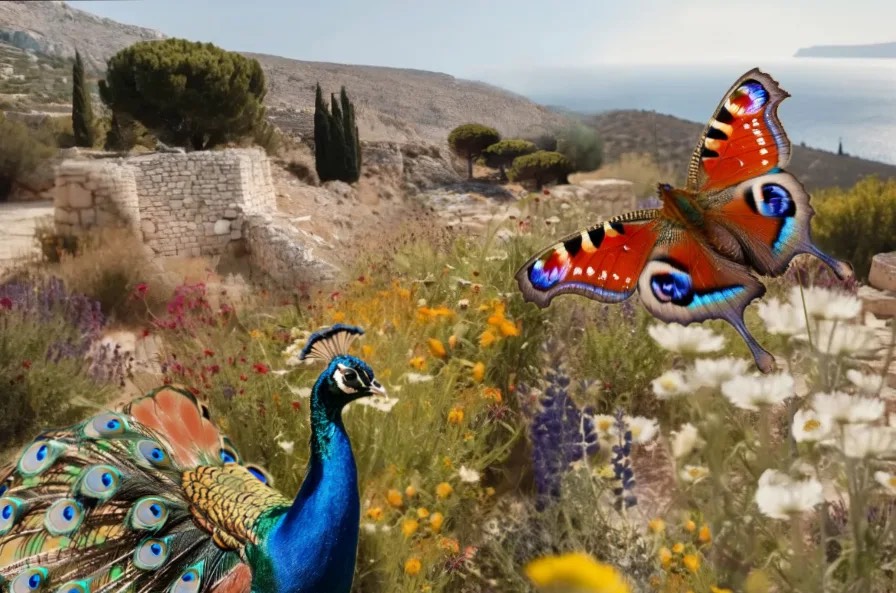
After Argos’ death, Hera honored him by placing his eyes as vibrant spots on a peacock’s tail and sent a horsefly to Io. She had done the same to Pegasus, the flying horse, who had thrown Io’s uncle Bellerophon off his back during their ascent to Mount Olympus. Io, seized by mania, attempted, in vain, to run away and escape from the fly. She ran along the east coast of Greece, giving her name to the sea (the Ionian Sea), then crossed into Asia Minor through the Bosporus (Cow Pass) Straits, and after passing by the black sea, the Caucasus, where Prometheus was chained, the land of the Amazons and the Gorgons, and galloping as far as India, finally passing through Arabia and Ethiopia, reached the land of the Nile.
Exhausted, she prayed to Zeus in desperation and moved by her suffering, he persuaded Hera to pardon her former priestess. Zeus turned her into a human again, and soon after, she gave birth to Epaphos—Zeus’s child by her. However, Hera, whose hatred for Io had not subsided, ordered the Curetes (legendary servants of Hera) to abduct the child. Io had to set off again, this time searching for Epaphhos, whom she found after a long search in Syria.
The vanity of Queen Cassiopeia was the cause of tragedy for Cepheus and his Aethiopian kingdom.
The arrogance and vanity of Cassiopeia offended the beautiful Nereids and their father, Poseidon.
On their return to Egypt, she erected a temple and statue of the goddess Demeter, who similarly had to search desperately for her daughter Persephone, according to the myths, and founded her worship. The Egyptians identified both Demeter and Io with Isis. This was the start of a long tradition where Ptolemaic queens, such as the eminent Berenice II (of Coma Berenices fame), would be worshiped as goddesses and identified with Isis and Aphrodite. Epaphos, son of Zeus and Io, would become the founder of the legendary royal houses of Egypt. His daughter (with Memphis) would be Lybia, and Lybia’s grandson would be Egypt. Later, Io married the king of Egypt, Telegonos, and, being a mortal, she eventually died.
According to some ancient sources, she died on the mountain of Silpium in Syria. There, her spirit revealed herself to the people her father sent to find her, and they founded the town of Iopolis, the city of Io, on the spot. There she would be worshiped as the goddess of the moon (Io means moon in an ancient dialect of Argos.) In the same area, a temple of Zeus is said to have been founded by the hero Perseus, and later, the great city of Antioch on the Orontes, the capital of the Hellenistic kingdom of the Seleucids, would be built and flourish to become one of the most populated cities of Antiquity.
The vanity of Queen Cassiopeia was the cause of tragedy for Cepheus and his Aethiopian kingdom.
The arrogance and vanity of Cassiopeia offended the beautiful Nereids and their father, Poseidon.
The vanity of Queen Cassiopeia was the cause of tragedy for Cepheus and his Aethiopian kingdom.
The arrogance and vanity of Cassiopeia offended the beautiful Nereids and their father, Poseidon.
After her death, Zeus placed her among the stars. Worshipped as a moon goddess, Io continues to leave her mark in the sky, as the first Galilean satellite of Jupiter (Zeus) was named Io, and more recently, a plateau on the southern hemisphere of Io, about 200 km long by 90 km wide and 4.5 km high, was fittingly named the plateau of Iopolis, “Iopolis planum.” On our planet, Io still wanders over the lands of Europe and temperate Asia as far east as Japan, in the form of the European peacock butterfly. The scientific name given to this beautiful and distinctive butterfly is “Inachis Io,” meaning “Io, daughter of Inachus.”