
Exploring
INTRODUCTION
Location:
Meaning:
Represents:
Symbolizes:
Key takeaways
- Centaurus is a large and bright constellation in the southern hemisphere.
- It is one of Ptolemy’s original 48 constellations.
- It represents a mythological centaur named Chiron. A half-human,half-horse creature known for his knowledge and benevolence, he was the mentor of numerous heroes like Asclepius, Actaion, Peleus, Jason, Heracles, Theseus, and Achilles.
- It contains the closest star, proximal Centauri, and the largest globular cluster, Omega Centauri.
Beginner’s map of CORVUS
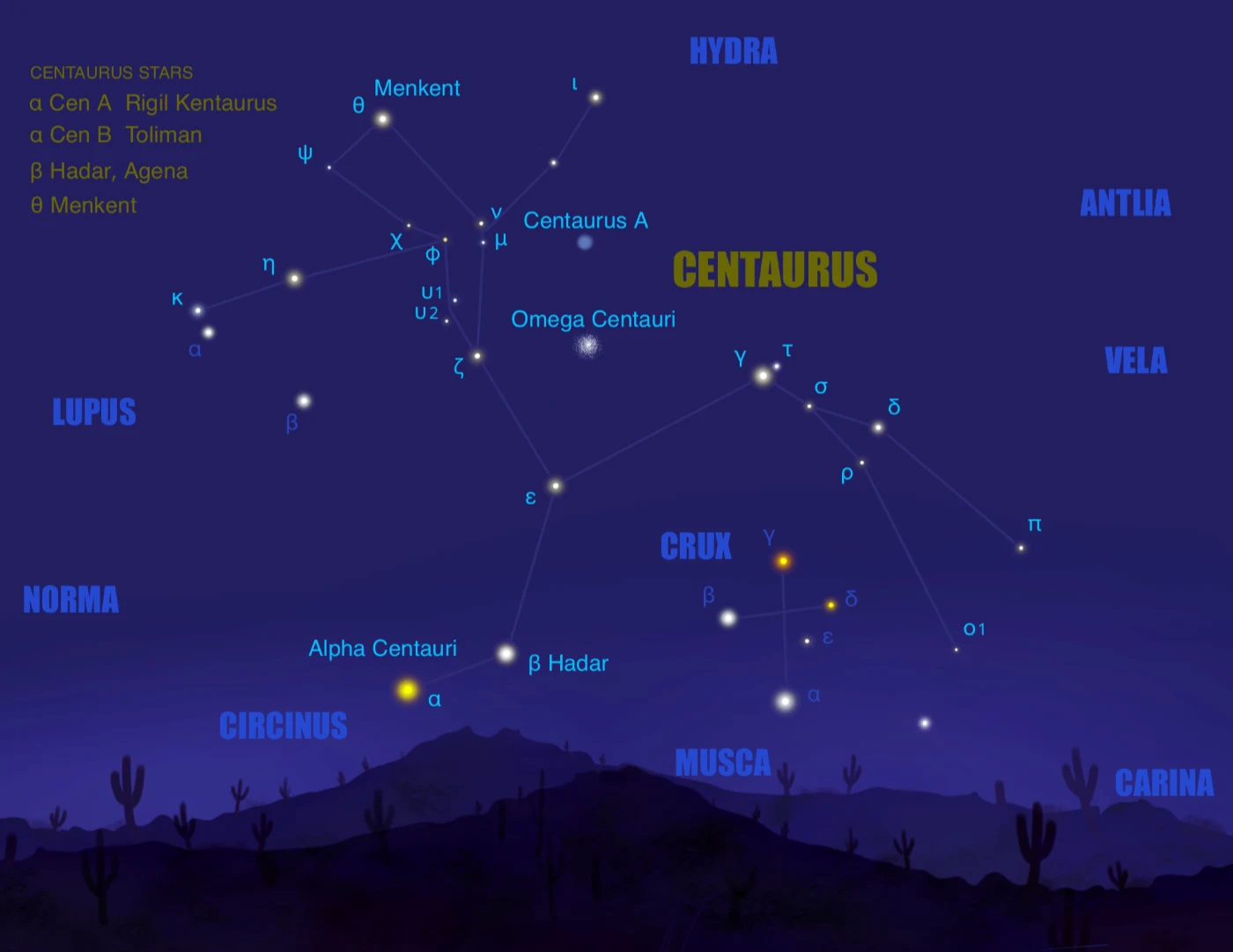
In the warm summer nights of the northern hemisphere, a magnificent constellation rises briefly over the southern horizon. However, what makes its ephemeral appearance even more tantalizing is that, for most observers, the majority of its treasures remain invisible, just under the horizon. Jewels like Alpha and Beta Centauri, its brightest stars, and the legendary globular cluster, Omega Centauri, either graze the horizon or miss rising by just a few degrees.
This, one of the sky’s most prominent constellations, is none other than the wisest and most famous of the centaurs, the centaur Chiron. Located in the epicenter of four adjacent constellations related to his myth, he is the most southern of the mythical heroes. In fact, due to its southerly declination and lack of clouds, Alexandria, Egypt, was considered an ideal place for his observation. What better city to observe the wisest of the centaurs than the city that housed the most prestigious library of the ancient world?
The rich mythology of Centaurus connects him with a multitude of constellations like Gemini, Ophiuchus, Argo, Lupus, Ara, Hercules, Sagittarius, and Pegasus. He is connected with the legendary ship of the Argonauts, Argo, through his connection with Jason and other Argonauts. He even raised the ill-fated Medio, the son of Jason and Medea. He is depicted leading a beast, Lupus, to the sacrificial altar, Ara. Asclepius, his student, connects him with Ophiuchus, and his daughter, Mellanippe, connects him with Pegasus, far away in the sky. Lastly, his death by one of the poisonous arrows of Heracles connects him with this summer constellation.
CENTAURUS myth
MYTH AT A GLANCE
Centaurs were mythological creatures that were half humans and half horses.
Diving deep into Greek legends and mythology, we find several myths about the origin of the centaurs. For some writers, they were the offspring of Apollo and the oceanid Hebe. Others believed they were the offspring of a monster born from the union of Ixion and Nefele, who mated with the horses of Magnesia. However, the prevalent version of their origin has to do with the primordial god Kronos (Saturn).
The centaur Chiron, an important figure in Greek mythology, was the son of Kronos (Roman Saturn) and the Oceanid nymph Philyra. Like Zeus, Chiron is the son of Saturn. Kronos, lusted after the nymph Philyra, and, one day, having transformed into a horse, he united with her by a beautiful lake on Mount Pelion in central Greece. Thus, the half-man, half-horse centaurs were born. He grew up under the protection of Apollo, as his father left after uniting with his mother, and Philyra turned into a linden tree from her unbearable grief for having given birth to such a disfigured child.
Centaur Chiron lived in a splendid cave on the flanks of Mount Pelion, a lush, coastal, high mountain near the modern city of Volos. Several characteristics made Chiron unique among the centaurs. He alone was immortal. He was famous for his brilliant and wise intellect and, in contrast to the other centaurs, benevolent character. According to the poet Pindar, his heart was full of love for mortals. These attributes, combined, made him an excellent teacher. It was a great privilege to be mentored by Chiron, a privilege reserved only for an elite group of ancient heroes.
Examples of the benevolent nature of Chiron are evident in many heroic stories. He saved the life of the father of Achilles, Peleus, by showing him where King Akastos had hidden his knife. Armed with it, Peleus defended himself from a flock of hostile centaurs and survived the attack. In another incident, he helped Peleus catch the goddess Thetis, the mother of Achilles, one night on the coast of Pelion.
The gods destined Thetis to marry the most virtuous mortal, Peleus. But she could change her appearance at will, often transforming herself into water, and Peleus could only catch her by following the advice of Chiron. After catching Thetis, Peleus married her, and Chiron offered him a spear made of apple tree wood as a wedding gift. Their son, the great hero Achilles, would eventually use this spear in the Trojan War.
Thetis, being a goddess, strived day and night to make her son immortal. But she returned to the realm of the sea before she could complete her mission. That left the almost immortal Achilles with a mortal spot on his heel. Peleus gave the infant Achilles to the Centaur Chiron, who raised him in Pelion and taught him the art of fighting and hunting.
Achilles was not the only hero raised by the kind centaur. He raised the argonaut Jason and his son with Medea, Medio, and even the god of medicine, Asclepius, son of Apollo and Coronis, teaching them the art and science of medicine, healing, and therapy. He mentored the famous physicians of antiquity, Machaon and Podalyrius, too. Machaon, son of Asclepius, was the physician who healed Menelaos when he was wounded by a Trojan arrow in the famous war. He used medicinal substances that Chiron had given to his father.
Achilles also learned the art of healing from the benevolent centaur. Patroclus treated the wound of a co-warrior hit by an arrow in the hip with the same methods and materials that Achilles had used. Chiron also brought up Aktaeon, son of Autonoe and Aristaeus, and taught him the art of hunting. He taught the same art to such eminent heroes as Castor, Polydeuces, Hippolytus, Meleager, and Theseus, among others. As for the art of war, he taught famous warriors like the Homeric stars Odysseus and Diomedes.
Chiron’s death was unexpected and inglorious. Heracles, his last pupil, accidentally took his life. This last chapter in the life of Chiron took place in the fourth of Heracles’s twelve labors. In this labor, he was tasked with exterminating the notorious Erymanthian boar. A fearsome boar that roamed on the Arcadian mountain Erymanthos and had taken the lives of many men and livestock.
During his quest, he was hosted by the centaur Pholos. While sitting at the table and enjoying their meal, Hercules asked for wine. Although Pholos was apprehensive about opening a wine jar belonging to all the centaurs, persuaded by Heracles, he opened it. The fears of Pholos came true as the wine’s smell from the communal jar alerted the centaurs, who soon after attacked them. In the ensuing battle, Heracles successfully defended the cave and even chased them away. During the chase, the centaurs sought refuge close to Chiron, whose knee was accidentally pierced by one of Heracles’s arrows.
This incident would hardly be cause for concern for the immortal Chiron if the arrow were not one of those that Heracles had dipped in the blood of Hydra, the hundred-headed monster. Chiron found himself in a bizarre situation. Although he was immortal, the blood of Hydra rendered the wound incurable, no matter how hard he tried. Desiring to end his misery, he asked Zeus to make him a mortal and gift his immortality to the mortal Prometheus. Zeus accepted, and Chiron was immortalized, this time among the stars.
However, according to another myth, Zeus, instead of Heracles, ended the life of Chiron. Zeus feared that Chiron, by prolonging excessively the stay of mortals on earth, would eventually bring imbalance to the universe. To avert this, he struck him with lightning, and Chiron shared the same end with Asclepius. He was placed in the sky, far from his daughter Hippe, or Melanippe, who is symbolized by the constellation Pegasus.
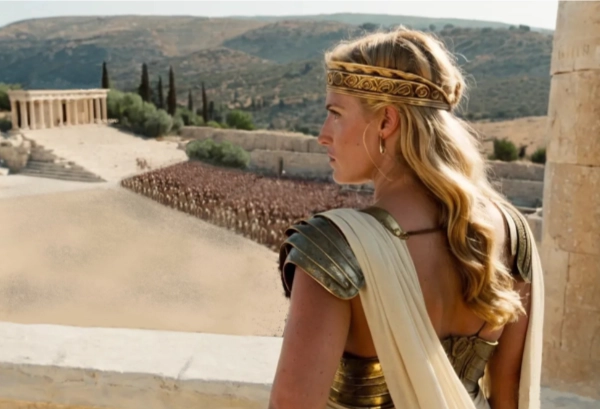
Hellen was wondering why she could not see her brothers among the Aechean army.

Temple of Castor and Polydeuces (Dioskouroi) at Aliki, Thassos Island, Greece.
According to Clement of Alexandria, (a theologian and philosopher), Chiron was the first to catalog the stars and create a celestial sphere long before Hipparchus created his own in 134 BC. Chiron gave that celestial sphere to Jason for guidance during their long, perilous journey.